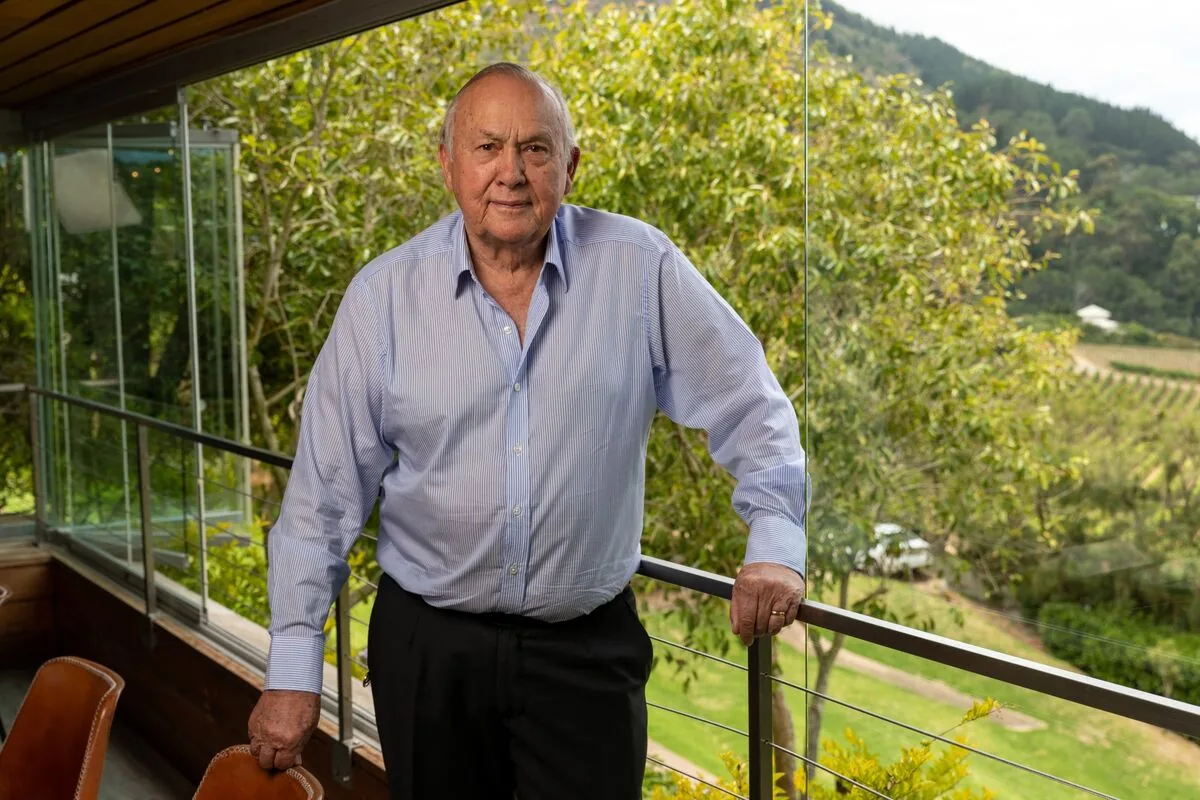

Who is Koos Bekker?
Jacobus Petrus “Koos” Bekker (born 14 December 1952, Potchefstroom) is one of the most consequential entrepreneurs South Africa has ever produced. As the longtime CEO and now chairman of Naspers — and chairman of its Amsterdam-listed subsidiary Prosus — he transformed a struggling Afrikaans newspaper publisher into one of the world’s most valuable consumer internet holding companies. His decision in 2001 to invest approximately $32 million for roughly a third of Tencent Holdings, the Chinese internet giant, is widely regarded as the single greatest return on investment in corporate history on a risk-adjusted basis.
As of May 2026, Forbes estimates Bekker’s net worth at approximately $3.5 billion (roughly R64.6 billion) — making him South Africa’s third-wealthiest resident, trailing only Johann Rupert and Nicky Oppenheimer. His fortune has had a volatile year: it briefly crossed $4 billion (approximately R73.9 billion) in January 2026 before Naspers and Prosus shares slid roughly 24% year-to-date, erasing around $500 million and pushing him back below the $4 billion threshold.
“Bekker took no salary, no bonus, and no perks for years as CEO of Naspers. He was compensated entirely through stock options — a bet on himself that turned into a multi-billion-rand fortune and one of the JSE’s greatest wealth-creation stories.”
Beyond his market wealth, Bekker is an increasingly prominent figure in the global luxury hospitality industry. Together with his wife, journalist and author Karen Roos, he owns three world-class estate properties — Babylonstoren in Franschhoek, The Newt in Somerset, England, and Fattoria di Vignamaggio in Tuscany, Italy — each a destination combining luxury accommodation, restaurants, working farms, and award-winning gardens. His story is one of the defining entrepreneurial narratives in South African business history.
Koos Bekker’s Net Worth in 2026 — USD and Rands
| Metric | Figure | Notes |
|---|---|---|
| Net Worth (USD) | ~$3.5 Billion | Forbes real-time, May 2026 |
| Net Worth (ZAR) | ~R64.6 Billion | At R18.47 per US dollar |
| January 2026 Peak | ~$4 Billion (~R73.9B) | Briefly SA’s #3 billionaire above $4B |
| 2026 YTD Loss | ~$500 Million (~R9.2B) | Naspers & Prosus shares down ~24% |
| SA Rank | #3 Resident | Behind Rupert (~R296B) & Oppenheimer (~R196B) |
| Global Forbes Rank | ~#1,220 | Forbes 2026 Billionaires List |
All ZAR figures calculated at R18.47 per US dollar. Net worth figures are estimates based on publicly disclosed shareholdings and market prices. Actual wealth may differ.
Early Life: From Potchefstroom to Columbia Business School
Koos Bekker was born on 14 December 1952 in Potchefstroom, in what is today South Africa’s North West province — the same town that would also produce fellow billionaire Ivan Glasenberg. He grew up in a modest Afrikaner household and attended Hoër Volkskool Heidelberg, where he excelled across the board: he was head boy, top academic performer, passed Afrikaans, English, Maths and Physical Sciences with distinction, chaired the debating society, played in the first cricket team, won the regional trophy as part of the first tennis team, and led the second rugby team to its league title.
After school, Bekker completed degrees in law and literature at Stellenbosch University and then studied law further at the University of the Witwatersrand. After graduating, he briefly worked as a state prosecutor — a career he quickly realised was not for him — and moved into advertising. Then, in the early 1980s, he and his wife Karen Roos made a defining bet on their future: they sold their house, borrowed money, and Bekker enrolled in the MBA programme at Columbia Business School in New York. He graduated in 1984, having written his thesis on pay-television businesses — HBO was his case study. That thesis would prove prophetic.
Building Naspers: From Newspaper Publisher to Global Tech Giant
After returning from Columbia in 1984, Bekker joined M-Net — the pioneering pay-television venture that would later become MultiChoice, the company behind DStv and Showmax. He rose through the ranks of the broader Naspers group, which at the time was a traditional Afrikaans newspaper publisher based in Cape Town. In 1997, Bekker was appointed CEO of Naspers — a position he held for 17 years until retiring from the executive role on 31 March 2014.
Under his stewardship, Naspers underwent a transformation that ranks among the most dramatic corporate pivots in global business history. When he took over, Naspers was a print media company with local reach. By the time he stepped back to the chairmanship in April 2015, it had become one of the world’s largest consumer internet holding companies — with operations in over 130 countries and a market capitalisation that made it South Africa’s most valuable company on the JSE by a wide margin. The Naspers he left behind was listed on both the Johannesburg Stock Exchange and the London Stock Exchange, and had spawned one of the largest technology investment portfolios outside the United States and China.
The engine of that transformation was a single decision made in 2001 — a decision that most of Naspers’s board initially questioned.
The Tencent Bet: The Greatest Investment in South African History
In 2001, Bekker authorised Naspers to invest approximately $32–34 million (roughly R250–330 million at then-prevailing exchange rates) for a stake of roughly a third of Tencent Holdings — a small Chinese internet company that had been founded in 1998 by Pony Ma and a group of co-founders in Shenzhen. At the time, Tencent was best known for QQ, an instant messaging platform. The investment looked bold. To many in the SA business press, it looked reckless.
It was neither. Tencent went on to build WeChat — the super-app used by over 1.3 billion people globally — and expanded into gaming, cloud computing, fintech, and digital advertising, becoming one of the most valuable companies on earth. Naspers’s original stake, gradually diluted over time but still substantial, is now held through Prosus and is worth hundreds of billions of rands. Naspers’s Tencent stake alone is worth more than most entire stock exchanges. The investment is widely studied in business schools globally as the single most successful technology bet of the 21st century on a risk-adjusted basis. Warren Buffett’s Berkshire Hathaway investment in Coca-Cola is often cited for comparison — but the returns from the Naspers-Tencent stake dwarf even that.
“A $32 million bet on a small Chinese messaging app in 2001 became a stake worth hundreds of billions of rands. No single investment decision made in South Africa has ever come close to generating the value that Bekker’s Tencent call created for Naspers shareholders.”
Bekker’s personal fortune is directly linked to this investment through his shareholding in Naspers. His salary during his CEO years was effectively zero — his entire compensation was in the form of stock options that vested over time. Every rand his net worth has accumulated is built on the back of the Tencent decision.
The Man Who Took No Salary: Bekker’s Unique Compensation Model
One of the most unusual aspects of Koos Bekker’s career is his compensation structure. For the majority of his time as CEO of Naspers, he drew no cash salary, no annual bonus, and no executive perks. His remuneration consisted entirely of stock option grants that vested through time — meaning his income was directly tied to Naspers’s share price performance. If the company did well, he did well. If it stagnated, he earned nothing.
The decision was both principled and strategic. Bekker believed that CEO pay should be aligned with shareholder outcomes rather than separated from them — a philosophy that was radical in South Africa in the late 1990s and early 2000s. By the time he stepped down as CEO in 2014, those vested options had turned him into a dollar billionaire many times over. His story has since become a fixture in South African business education as an example of long-term aligned incentives — and a rebuke to the culture of guaranteed executive bonuses regardless of performance that remains common in SA’s listed company sector.
Prosus: The Amsterdam Listing That Unlocked Global Capital
In 2019, Naspers spun out its international internet assets into a new entity — Prosus N.V. — listed on the Euronext exchange in Amsterdam, with a secondary listing on the JSE. The structure was designed to close the persistent discount at which Naspers traded relative to the underlying value of its Tencent stake — a discount that at its peak meant the market was valuing all of Naspers’s other businesses at negative rands. By listing Prosus separately and giving international investors direct access to a vehicle holding the Tencent stake, the Naspers board aimed to unlock that value.
The discount has narrowed but never fully closed, and it remains one of the ongoing puzzles of South African corporate finance. Bekker chairs both Naspers and Prosus and continues to be deeply involved in the strategic direction of both entities. His family trust retains a significant stake in both — holding approximately 0.85% of Naspers directly, worth several billion rands, with additional indirect exposure through the trust structure. As of the latest disclosures, the Bekker family trust retained 90% of its pre-disposal holdings in both Naspers and Prosus even after the December 2025 share sales.
Babylonstoren, The Newt & Vignamaggio: Bekker’s Estate Empire
In parallel with his business career, Koos Bekker and Karen Roos have built one of the most remarkable privately owned luxury estate portfolios in the world. It began in 2007 when they acquired Babylonstoren — a historic Cape Dutch farm near Franschhoek in the Western Cape, with architecture dating back to 1690. Spanning nearly 600 acres, Babylonstoren features a working fruit farm, a vineyard, an iconic 3.5-acre garden divided into 15 sections (one of the most photographed gardens in South Africa), a boutique hotel, and two celebrated restaurants. It has grown into one of South Africa’s premier travel destinations and a globally recognised brand in agritourism.
The second estate is The Newt in Somerset, England — a 300-hectare property in the English countryside acquired and transformed into a luxury hotel with gardens, a spa, a cider farm, and a working winery. It has become one of the most lauded hotel openings in Britain in the past decade and regularly features in global best-hotels lists. The third is Fattoria di Vignamaggio, a historic Tuscan wine estate near Florence in Italy — reputedly the birthplace of Lisa Gherardini, the subject of Leonardo da Vinci’s Mona Lisa. The estate produces wine and olive oil alongside luxury accommodation. Together, these three properties represent a deliberate long-term investment philosophy: acquire undervalued physical assets with historical significance, apply world-class design and hospitality, and build enduring brands.
Net Worth Breakdown: What Does Koos Bekker Actually Own?
| Asset | Estimated Value | Notes |
|---|---|---|
| Naspers stake (direct & trust) | Majority of net worth | ~0.85% direct stake; additional trust exposure. Value fluctuates with JSE price. |
| Prosus stake (trust) | Included in above | Euronext-listed; trust retained 90% post Dec 2025 disposals |
| Babylonstoren (Franschhoek, SA) | Estimated R1B+ | Nearly 600-acre luxury farm estate; operating hotel & restaurant |
| The Newt (Somerset, England) | Estimated R2B+ | 300-hectare luxury hotel & garden estate; award-winning destination |
| Vignamaggio (Tuscany, Italy) | Estimated R1B+ | Historic Tuscan wine estate; produces wine & olive oil |
| Other private investments | Undisclosed | Proceeds from R8.9B in share sales partially reinvested in estates |
Estate property values are estimates. Naspers and Prosus shareholding values fluctuate with market prices and are the primary driver of Bekker’s total net worth figure as reported by Forbes.
Koos Bekker vs Johann Rupert: SA’s Two Biggest Fortunes Compared
South Africa’s two most prominent billionaires built their fortunes through very different paths — but both ultimately did it by making a single early strategic bet and then compounding it relentlessly over decades. Rupert built Richemont by separating his father’s European assets into a Swiss luxury company and then riding the global supercycle in demand for Cartier, IWC, and Van Cleef & Arpels watches and jewellery. Bekker built his fortune by redirecting a South African newspaper group’s capital into Chinese internet — a sector most South African institutional investors still barely participated in a decade later.
| Metric | Koos Bekker | Johann Rupert |
|---|---|---|
| Net Worth (USD) | ~$3.5B | ~$15–16.1B |
| Net Worth (ZAR) | ~R64.6B | ~R277–297B |
| SA Rank | #3 Resident | #1 Resident |
| Primary Asset | Naspers / Prosus (Tencent) | Richemont (Cartier, IWC) |
| Wealth Built On | Tech investing (China) | Global luxury goods |
| Base | Franschhoek, Western Cape | Stellenbosch, Western Cape |
The gap between the two fortunes reflects the different scales of their primary assets. Richemont is a global luxury empire generating billions in annual profit; Naspers and Prosus trade at persistent discounts to their underlying asset value. If that discount were ever fully closed, Bekker’s net worth would be dramatically higher. It is one of the most discussed anomalies in South African corporate finance.