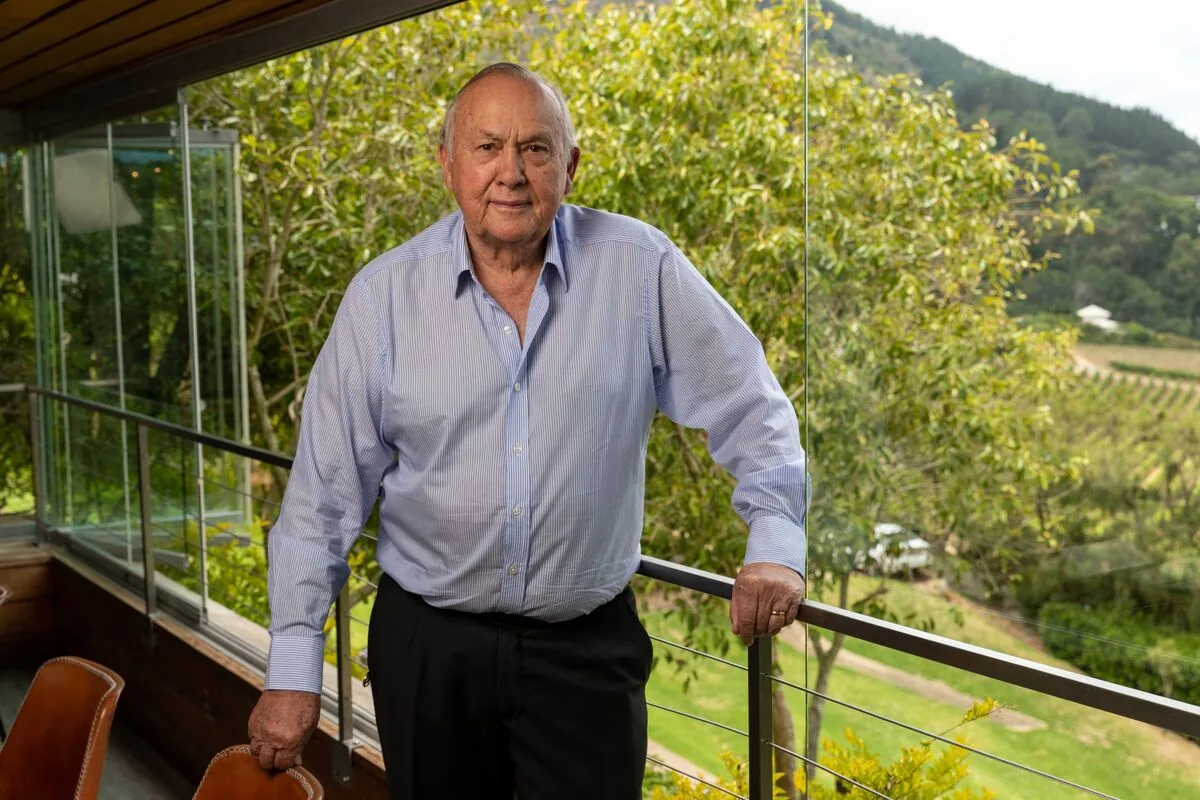

Who Is Jannie Mouton?
Johannes “Jannie” Mouton is a South African billionaire and one of the country’s most remarkable entrepreneurs. He is the founder of PSG Group — an unlisted investment holding company headquartered in Stellenbosch that has seeded some of South Africa’s most successful businesses, including Capitec Bank, Curro Holdings, and PSG Konsult. His net worth as of May 2026 stands at approximately $2.2 billion, making him the sixth-wealthiest person resident in South Africa according to Forbes.
What makes Mouton’s story unusual — and unusually compelling — is that his billionaire journey began not with a great success, but with a brutal dismissal. He was fired at the age of 48 from the stockbroking firm he co-founded. Instead of retreating, he started over. Within months he had acquired control of a small listed company for R3.5 million and began constructing what would become one of South Africa’s most powerful financial empires. He later turned that story into a book: And Then They Fired Me — an autobiography that has become required reading in South African business circles.
“Mouton is widely known in South African business circles as the ‘Boere-Buffett’ — a nickname coined by the financial website Moneyweb in recognition of his long-term, value-compounding approach to building and backing businesses.”
Today, PSG Group continues as an unlisted investment holding company, with the Mouton family retaining an 87% interest. Its focus remains on backing early-stage South African businesses with high growth potential and building them alongside their management teams. Mouton stepped down as non-executive chair of PSG Group and its subsidiaries in November 2018 due to medical reasons, but his influence — and the fortune built over three decades — endures. His son Piet Mouton now serves as CEO of PSG Group.
Jannie Mouton Net Worth 2026 — Full Breakdown
| Wealth Source | Type | Contribution to Net Worth |
|---|---|---|
| PSG Group (unlisted) | Investment holding company | Primary asset — 87% family stake |
| Capitec Bank | JSE-listed retail bank | Major indirect holding — early investor |
| PSG Financial Services | JSE-listed wealth management | 13% family trust stake (end 2025) |
| Curro Holdings | Private schooling group (being delisted) | R7.2B Stigting acquisition (Aug 2025) |
| KAP Industrial | JSE-listed industrials & logistics | Indirect exposure post-2022 restructure |
| Stadio Holdings | Private higher education | Indirect exposure post-2022 restructure |
Net worth estimates reflect Forbes real-time data (May 2026) and BusinessTech reporting. The Mouton family wealth is structured primarily through trusts and the unlisted PSG Group, making precise independent verification difficult. The $2.2B figure is the most widely cited current estimate.
Early Life & Education
Johannes “Jannie” Mouton was born in 1946 in Carnarvon — a small, isolated town in the Northern Cape, surrounded by sheep farms and semi-arid Karoo landscape. He grew up there, far from the commercial centres of Cape Town or Johannesburg, in an environment that gave him little natural access to finance or business networks. He matriculated in 1964 and went on to study at Stellenbosch University, where he completed a BCom Honours degree — following in his father’s footsteps at the same institution.
After graduating, Mouton began his career as an articled clerk at Coopers Brothers (now PricewaterhouseCoopers), where he qualified as a chartered accountant in 1973. He went on to work in accounting roles at Federale Volksbeleggings, Veka, and Kanhym before making his move into financial markets. In 1982, he co-founded the stockbroking firm Senekal, Mouton & Kitshoff alongside Johan Senekal and Jannie Kitshoff. He became its managing director in 1987 and spent over a decade building the business — until the day his partners decided he had to go.
The Day He Was Fired at 48
On 3 August 1995, Jannie Mouton walked into the offices of Senekal, Mouton & Kitshoff as managing partner — and walked out without a job. His co-founders had forced him out. The cause was a strategic disagreement: Mouton wanted to transform the firm into a full-scale financial conglomerate; his partners did not. The board sided against him, and he was gone.
He was 48 years old, with no employer, no obvious next step, and a set of ambitions his former partners had just voted down. Most people, at that age, in that position, would have recalibrated. Mouton did not. He later described the firing as the moment that put his life on a new course — one he could not have found if he had stayed. In his own words, written in And Then They Fired Me: “I had to delve deep, think a lot, learn and also make mistakes to get where I am now.” Within months of the dismissal, he was already building his next company. The story of that rebuilding is what makes Mouton one of South Africa’s most instructive entrepreneurial figures.
“The day he was fired at 48 became the founding myth of PSG Group — and arguably the most important day in the history of South African financial services entrepreneurship in the past three decades.”
Building PSG Group from R3.5 Million
In November 1995 — just months after his dismissal — Mouton partnered with business partner Chris Otto and acquired a 51% controlling stake in PAG Limited, a small JSE-listed recruitment company, for R3.5 million. That was the beginning. In 1997, they sold PAG Placements for R107 million and renamed the holding company PSG Group, pivoting its focus entirely toward financial services and investments. In 1998, PSG raised R1.2 billion for PSG Noble Capital, which listed on the JSE. PSG Noble and PSG Investment Bank subsequently merged in 1999, forming the core of what PSG Group would become.
The PSG model — at its heart — was straightforward: identify high-quality South African businesses at early or undervalued stages, back them with capital and expertise, and compound over time. What set PSG apart from conventional private equity was its willingness to stay invested for the long term and to build management teams rather than simply extract returns. Over two decades, PSG backed and helped build Capitec Bank, Curro Holdings, PSG Konsult (now PSG Financial Services), KAP Industrial, Zeder Investments, and Stadio Holdings. The combined value created across those businesses dwarfs the original R3.5 million starting point by a factor that is almost incomprehensible.
Mouton stepped down as non-executive chair of PSG Group and its subsidiaries in November 2018 for medical reasons, after 23 years at the helm. His son Piet Mouton took over as CEO. The Mouton family retains an 87% interest in the unlisted PSG Group, which continues to operate as an incubator for early-stage South African businesses across energy, education, retirement lifestyle villages, and financial services — headquartered at 35 Kerk Street, Stellenbosch.
The Capitec Bank Investment
Of all the businesses PSG Group backed under Mouton’s leadership, none has been more consequential — financially or socially — than Capitec Bank. In 2001, PSG partnered with Michiel le Roux to co-found Capitec on a deceptively simple premise: South Africa’s big four banks were too expensive, too complicated, and too inaccessible for ordinary South Africans. Capitec would be different — low fees, simplified products, accessible branches, and a mobile-first philosophy long before the rest of the industry caught up.
PSG provided the critical early capital and institutional backing that allowed Capitec to survive its vulnerable launch years and grow into a genuine challenger bank. The bet paid off on a scale that few could have anticipated. By 2026, Capitec serves over 22 million active clients — making it South Africa’s most popular retail bank by customer numbers, ahead of Standard Bank, FNB, and Absa. Its share price has compounded dramatically over two decades on the JSE, and the wealth it has created for its early backers — including both Mouton and le Roux — is one of the JSE’s great long-term wealth-creation stories. Michiel le Roux’s own net worth of approximately $3.4 billion is a direct reflection of that early Capitec conviction.
Curro Holdings & The R7.2B Philanthropic Deal
Curro Holdings — South Africa’s largest private school group — was another PSG-incubated business, listed on the JSE and built over more than a decade into a network of affordable private schools serving families across the country. It was, for many years, one of PSG’s flagship public investments. Then, on 27 August 2025, Mouton’s personal foundation — the Jannie Mouton Stigting — announced it would redirect the largest share of its capital, R7.2 billion, to acquire and delist Curro from the JSE.
The purpose was not commercial. The Jannie Mouton Stigting repositioned Curro as a public benefit organisation with a mandate to expand quality schooling for children from disadvantaged backgrounds and increase bursary access across South Africa. The foundation described the move as the largest single philanthropic gesture in South African history. It is a striking use of compounded wealth — taking a business built for profit and redirecting it entirely toward public good. Mouton founded the Jannie Mouton Stigting in 2017 with an initial endowment of 10.5 million PSG shares; by 2025 it had paid out dividends of over R100 million to more than 100 welfare organisations, including children’s homes, soup kitchens, and support organisations for people with disabilities.
The 2022 PSG Restructure & What Came After
In 2022, PSG Group undertook a significant structural overhaul — unbundling its stakes in PSG Financial Services, Curro, KAL Group, and Stadio directly to shareholders. The rationale was to give investors direct exposure to each underlying business, rather than holding them through a conglomerate discount layer. It was a clean, shareholder-friendly move that effectively broke PSG Group’s listed structure apart and transformed it into a purely unlisted entity focused on incubating new businesses.
Post-restructure, the Mouton family trust retained a 13% stake in PSG Financial Services by end of the 2025 financial year. That stake was subsequently reduced as part of the capital redeployment into the Curro acquisition by the Jannie Mouton Stigting. PSG Financial Services — originally founded as PSG Konsult in 1998 by Willem Theron and Wallie Krumm — has continued to grow strongly in its own right, with a market capitalisation of approximately R32 billion as of early 2026 and earnings per share expected to rise between 36% and 39% for the year ended February 2026. Piet Mouton serves on the PSG Financial Services board as an independent non-executive director, maintaining the family’s connection to the business even as direct ownership has evolved.
Personal Life, Family & Legacy
Jannie Mouton lives in Stellenbosch, the Western Cape university town that is also home to PSG Group’s headquarters. He is known for being outspoken, direct, and unafraid of controversy — qualities that run through both his autobiography and his public statements over the years. He has a passion for poetry, somewhat at odds with the reputation of a hard-nosed financier, and is described by colleagues as someone who combines commercial ruthlessness with genuine warmth.
His first wife, Dana Mouton, passed away in 2004. He later married Deidré (née De Villiers) Uys. He has two sons — Jan and Piet — and a daughter, Charité. Piet Mouton is now CEO of PSG Group, while Jan manages the PSG Flexible Fund and serves as a non-executive director of PSG. The family’s involvement in the business is deep and multigenerational, a deliberate design reflecting Mouton’s view that PSG should be built for decades, not quarters. In 2016, Mouton donated R50 million to Stellenbosch University for the Jan Mouton Centre of Learning, named after his father — a gesture that reflects his sense of rootedness in the institution and region that shaped him.
How Does Jannie Mouton’s Wealth Compare?
Within South Africa’s resident billionaire landscape, Mouton sits at approximately sixth position as of May 2026. His $2.2 billion net worth is substantial but well below the top tier dominated by Johann Rupert (~$15–16.1B) and Nicky Oppenheimer (~$10.6B). It is, however, broadly comparable to that of Michiel le Roux (~$3.4B) — Capitec’s co-founder and Mouton’s long-time collaborator — reflecting how intertwined the two fortunes are through their shared early bet on that bank.
| SA Resident Billionaire | Net Worth (May 2026) | Primary Wealth Source |
|---|---|---|
| Johann Rupert | ~$15–16.1B | Richemont (Cartier, IWC), Remgro |
| Nicky Oppenheimer | ~$10.6B | De Beers sale, Oppenheimer Generations |
| Patrice Motsepe | ~$3.9B | African Rainbow Minerals, Sanlam |
| Koos Bekker | ~$3.5B | Naspers/Prosus (Tencent stake) |
| Michiel le Roux | ~$3.4B | Capitec Bank (founder’s stake) |
| Jannie Mouton | ~$2.2B | PSG Group, Capitec, Curro |
| Christo Wiese | ~$1.88B | Shoprite, Pepkor |
| Paul van Zuydam | ~$1.72B | Le Creuset |
All figures are Forbes estimates as of May 2026. SA resident list applies Forbes residency criteria. For the full rankings and profiles, see our Richest South Africans 2026 guide.