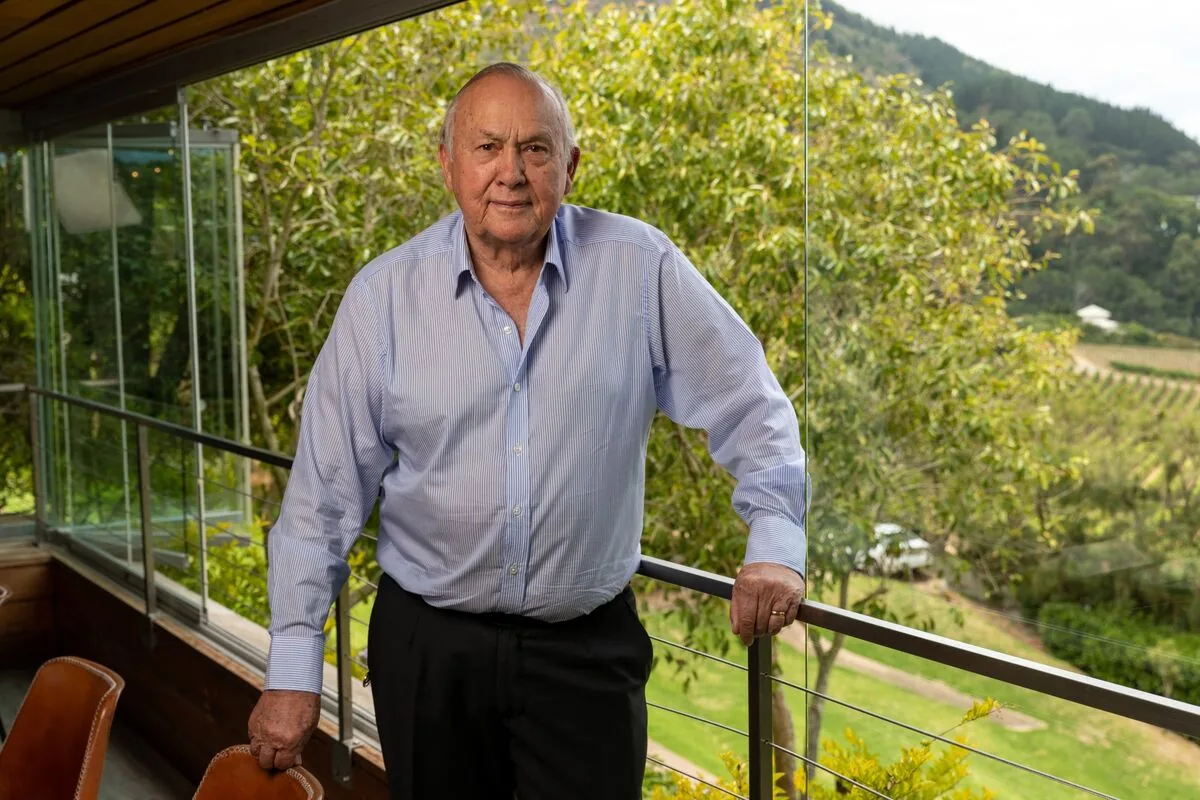

Who Is Natie Kirsh?
Nathan “Natie” Kirsh (born 6 January 1932, Potchefstroom, South Africa) is a South African-born billionaire entrepreneur and one of the most extraordinary self-made business figures of the 20th and 21st centuries. Most people in South Africa had never heard his name before March 2026. That was entirely by design. For nearly five decades, Kirsh quietly built the largest cash-and-carry wholesale food business in the United States — Jetro Restaurant Depot — without ever listing it on a stock exchange, seeking media coverage, or accepting outside capital beyond a single strategic investment in 2019. Then, at 94 years old, he sold it to Sysco Corporation for $29.1 billion (approximately R484 billion) — one of the largest deals in US food service history.
The transaction made Kirsh the second-wealthiest person of African origin on the planet, behind only Nigerian billionaire Aliko Dangote. It pushed his net worth past that of Johann Rupert — South Africa’s long-standing wealthiest resident — and placed him firmly among Africa’s top two billionaires. Forbes estimated his net worth at $17.6 billion (approximately R324 billion) in April 2026. Bloomberg Billionaires Index placed him at approximately $17.1 billion (R314 billion), noting a single-day increase of around $5 billion when the Sysco deal was announced on 30 March 2026.
He is a key figure in the story of what South African entrepreneurs have built beyond the country’s borders — a story that also includes figures like Elon Musk and Ivan Glasenberg. Kirsh lives in Ezulwini, Eswatini (formerly Swaziland), where he holds citizenship. He also holds residency in the UK and the United States. He is married to Frances Herr, and they have three children.
“We literally have no competition.” — Natie Kirsh, speaking about Jetro at the London Business School, 2011.
Natie Kirsh Net Worth in 2026 (USD & ZAR)
| Source | Net Worth (USD) | Net Worth (ZAR ~R18.35/$) | Date |
|---|---|---|---|
| Forbes | $17.6 Billion | ±R323 Billion | April 2026 |
| Bloomberg Billionaires | ~$17.1 Billion | ±R314 Billion | March 31, 2026 |
| Celebrity Net Worth | ~$20 Billion | ±R367 Billion | April 2026 |
| IOL / BusinessTech | ~$17.8 Billion | ±R327 Billion | May 2026 |
ZAR conversions are approximate at R18.35 = $1 USD. Estimates vary because Jetro was a privately held company with no public reporting obligations prior to the Sysco transaction. Kirsh’s stake in Jetro has been reported at 52% (Bloomberg, adjusted for FEMSA dilution), ~70% (Forbes), and 75% (Celebrity Net Worth / Billionaires.Africa). The $29.1B deal value includes approximately $5 billion in debt.
Before the deal, Kirsh had not appeared prominently on international wealth rankings. In April 2025, Forbes had valued him at approximately $7.3 billion (roughly R134 billion at the time). The Sysco transaction more than doubled that figure virtually overnight, placing him comfortably ahead of Johann Rupert (~$15.9 billion / R292 billion), Nicky Oppenheimer (~$10.6 billion / R195 billion), and Patrice Motsepe (~$3.9 billion / R72 billion) on Africa’s wealth rankings.
The $29.1 Billion Jetro Deal Explained (R484 Billion)
On 30 March 2026, Sysco Corporation — the world’s largest food distributor — announced it had agreed to acquire Jetro Restaurant Depot LLC for $29.1 billion (approximately R484 billion) including debt. Under the terms of the transaction, Jetro shareholders were to receive $21.6 billion in cash and 91.5 million Sysco shares (representing approximately 16% of Sysco’s total stock at announcement). The deal represented a multiple of more than 14 times Jetro’s 2025 operating income of $2.1 billion.
The transaction is expected to close by the third quarter of Sysco’s fiscal year 2027, pending regulatory approval. Jetro will operate as a standalone segment within Sysco, with its existing leadership team remaining in place and two of its directors joining Sysco’s board. Sysco projected the deal would be immediately accretive to margins, earnings per share, and free cash flow, with approximately $250 million in annualised net cost synergies achievable within three years.
For Natie Kirsh, the deal was the culmination of nearly 50 years of building. He had declined investment inquiries from some of the world’s most prominent investors. In 2003, Warren Buffett agreed in principle to buy a minority stake in Jetro Holdings — the two men could not agree on terms, and Buffett walked away. Kirsh kept building. When Sysco made its offer in 2026, at a valuation few analysts had anticipated, he said yes.
The deal sent shockwaves through South Africa’s financial press. BusinessTech ran the headline: “The man from Potch who once owned Checkers, lost almost everything, and is now richer than Johann Rupert.” The Financial Mail devoted its April 2026 cover to asking whether such an empire could have been built in South Africa — and reached an uncomfortable but important conclusion: probably not.
Early Life: From Potchefstroom to Eswatini
Nathan Kirsh was born on 6 January 1932 in Potchefstroom, a small city in what is now the North West province of South Africa, roughly 120 km west of Johannesburg. His parents were Lithuanian Jewish immigrants who had come to South Africa in the early 20th century. The family ran a concession store selling blankets and supplies to mine workers, and operated a small sorghum malt factory in the city. Natie attended Potchefstroom Boys High School, matriculating in 1949, and went on to earn a Bachelor of Commerce from the University of the Witwatersrand in 1952 — the same institution that has produced a disproportionate share of South Africa’s corporate leaders.
When his father died, Kirsh used the family’s insurance payout to expand into Eswatini (then Swaziland), where he replicated the family’s malt business. In 1958, he launched his own milling business in Eswatini, securing an agreement with the local government that gave him a near-monopoly on purchasing and importing corn into the country. That venture proved highly profitable and gave him his first real capital base — enough to buy back his father’s original malt business in Potchefstroom and begin expanding into South Africa’s distribution and retail sectors.
Building a South African Empire — and Losing It
Through the 1960s and 1970s, Kirsh built one of the most formidable distribution and retail empires in southern Africa. He acquired Moshal Gevisser, a major South African distribution business, in 1970, expanding into consumer goods supply across the country. He grew to control over 12% of South Africa’s consumer goods market, and his portfolio eventually included the Checkers supermarket chain — which he later sold to Shoprite. At the height of his South African empire, he was one of the most powerful businessmen in the country.
In the early 1980s, Kirsh made a catastrophic bet on South African real estate. The property market collapsed, and so did much of his South African fortune. In 1984, Sanlam — the insurance giant — purchased a 49% stake in his South African conglomerate. Two years later, Sanlam effectively pushed him out. In 1986, at the age of 54, Kirsh left South Africa permanently. He took almost nothing with him from his South African business interests. The one asset he did retain control of was a single cash-and-carry warehouse he had quietly opened a decade earlier in Brooklyn, New York — Jetro.
It is a story that resonates deeply in the context of how South Africa’s most ambitious entrepreneurs have historically been shaped by the country’s institutional and economic environment. Kirsh’s exit from South Africa and the empire he built abroad have since become a defining case study in what South African business talent looks like when operating in a different regulatory and economic context.
How Kirsh Built Jetro from a Single Brooklyn Warehouse
Kirsh had opened his first Jetro Cash & Carry warehouse in Brooklyn, New York, in June 1976 — a decade before he left South Africa. The model was deliberately unglamorous and borrowed directly from the cash-and-carry wholesale concepts he had perfected in southern Africa. No delivery. No salespeople. No credit. Customers — independent restaurant owners, bodegas, food truck operators, caterers, and small food service businesses — arrived at the warehouse, loaded their own trolleys, paid cash or by card at the counter, and left. By cutting out all the overhead that traditional distributors carried, Jetro was able to undercut Sysco and other full-service distributors by roughly 20% on price, while still generating exceptional margins.
In 1994, Kirsh acquired Restaurant Depot, a sister operation targeting food service businesses, which became a second brand under Jetro Holdings and extended the same model to a different customer segment nationwide. Over the following three decades, Jetro expanded from that single Brooklyn store into 166 large-format warehouse locations across 35 US states, serving over 725,000 independent restaurant and foodservice operators. Kirsh kept the business entirely private throughout — no stock exchange listing, no public reporting, minimal media coverage. In 2019, Mexican conglomerate FEMSA invested $750 million into Jetro, the only outside capital Kirsh had ever accepted, which slightly diluted his stake.
By 2025, Jetro generated $16 billion in annual revenue and $2.1 billion in EBITDA — and had recorded 30 consecutive years of EBITDA growth, including through the 2008 global financial crisis and the Covid-19 pandemic. The business’s compound annual discipline over five decades is virtually without parallel in US food distribution history.
Natie Kirsh’s Assets: Property, Ki Corporation & Global Investments
Beyond Jetro, the Natie Kirsh net worth picture includes a substantial global property and investment portfolio held through his private holding company, Ki Corporation Limited. His real estate holdings span four continents and include some notable landmark assets.
In London, Kirsh owns Tower 42 — the City of London’s first proper office skyscraper, located in the heart of the financial district. He also holds significant Australian real estate through Ki Corporation, including a ~50% controlling stake in Abacus Property Group, a publicly traded Australian real estate investment trust, and a 39.6% stake in Abacus Storage King, another Australian REIT. Birkenhead Point, a major waterfront shopping centre in Sydney, is also part of his portfolio. His property investments give his net worth a significant floor that is independent of the Jetro deal.
In Eswatini, where he has lived since leaving South Africa in 1986, Kirsh also holds substantial business and property interests that formed the foundation of his early fortune. His holding in the malt and food distribution businesses he originally built in the country persisted through the decades even as he built Jetro in the US. He is one of Eswatini’s most prominent private investors and has been a significant employer in the small southern African kingdom for over six decades.
Natie Kirsh vs Johann Rupert: How They Compare
| Natie Kirsh | Johann Rupert | |
|---|---|---|
| Net Worth (May 2026) | ~$17.6B / R323B (Forbes) | ~$15.9B / R292B (Forbes) |
| Born | 1932, Potchefstroom | 1950, Stellenbosch |
| Residence | Eswatini / UK / USA | Stellenbosch, South Africa 🇿🇦 |
| Primary Wealth Source | Jetro Restaurant Depot (sold 2026), Ki Corp property | Richemont (Cartier, IWC), Remgro, Reinet |
| Wealth Built | USA, Eswatini, UK, Australia | Switzerland, South Africa, globally |
| Forbes Africa Resident List | Not listed (Eswatini resident) | #1 SA resident billionaire |
The comparison matters because Johann Rupert has held the title of South Africa’s wealthiest person — by residency — for most of the past two decades. Kirsh, despite now holding a larger personal fortune on most rankings, does not appear on Forbes’s official Africa resident list because he lives in Eswatini. For a full view of how both men’s fortunes compare to other South African billionaires, see our guide to the richest South Africans in 2026.
What Entrepreneurs Can Learn from Natie Kirsh
The Natie Kirsh story is more than a net worth number — it is a masterclass in a specific kind of entrepreneurial discipline that South Africa’s business community rarely gets to study in depth, precisely because Kirsh operated so far from the public eye for so long. Several principles stand out from his 50-year track record:
Model simplicity compounds over time. The Jetro cash-and-carry model is not complicated. Buy in bulk, sell at low margins, eliminate delivery costs, serve customers no one else wants to serve. Kirsh applied this model consistently for nearly five decades and generated 30 consecutive years of EBITDA growth. No pivots. No reinventions. The same formula, scaled.
Privacy is a competitive advantage. Jetro had no advertising budget, no PR team, and no investor relations department. Kirsh gave almost no interviews. His competitors knew broadly what he was building, but they never had the leverage that public shareholders or a listed share price would have given them. He kept control completely and never allowed outside capital to dilute his decision-making — except for a single $750 million FEMSA investment in 2019, which he accepted on his own terms.
Rebuilding after catastrophe is possible. By the mid-1980s, Kirsh had lost his South African empire — a business that had controlled over 12% of the country’s consumer goods market — to a real estate crash and a forced exit engineered by Sanlam. He left South Africa at 54 with Jetro, a then-decade-old warehouse business in Brooklyn, as his primary remaining asset. He rebuilt from there into a $29 billion empire. It is one of the most remarkable second acts in global business history. The same spirit of rebuilding after adversity is visible in the stories of other South African entrepreneurs like Christo Wiese, who rebuilt his fortune after the Steinhoff collapse wiped out R59 billion of his wealth.
Patience is the rarest form of capital. Kirsh declined Warren Buffett’s approach in 2003. He was already in his early 70s. He said no. He kept building for another 23 years before selling — at 94 — for $29 billion. The time horizon that generated that outcome is almost incomprehensible in the context of modern financial markets.