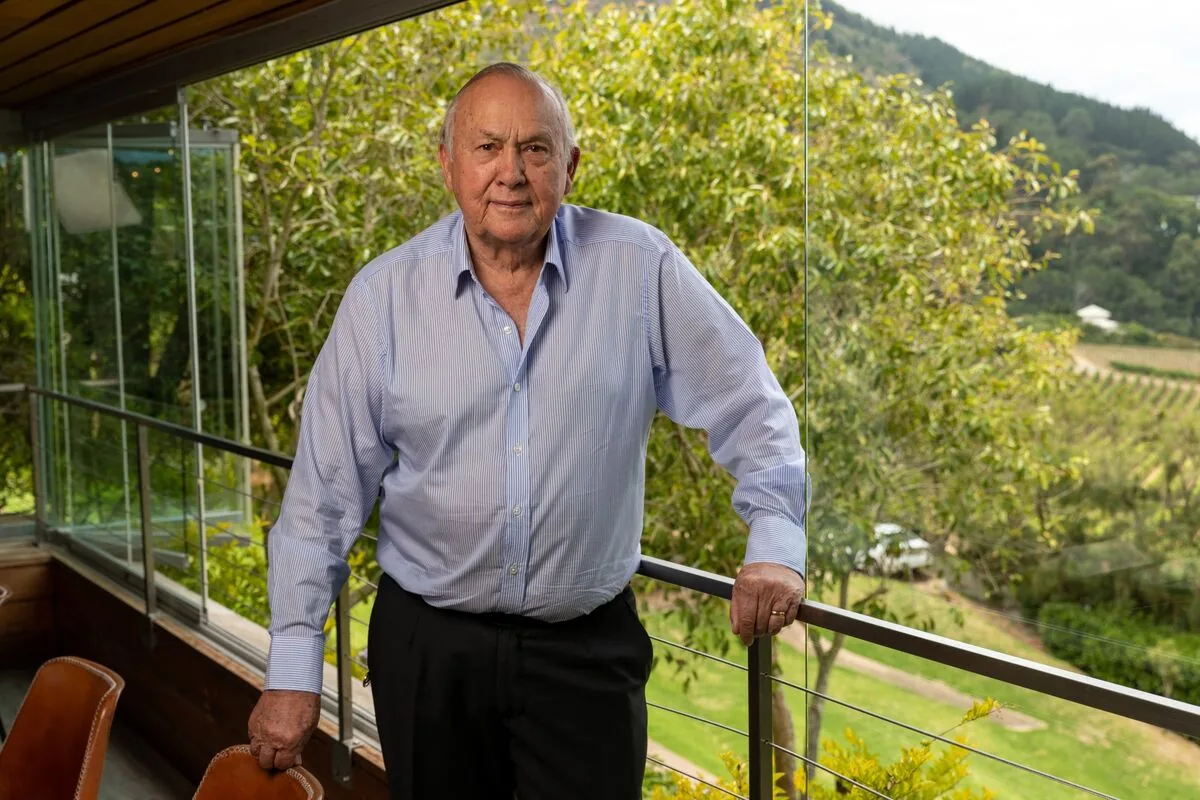
Who Is Michiel le Roux?
Michiel Scholtz du Pré le Roux (born 20 May 1949) is a South African billionaire businessman, co-founder of Capitec Bank, and one of the most consequential entrepreneurs in South African financial history. His net worth in 2026 is estimated at between $2.6 billion and $3.4 billion, depending on the source and timing — a figure almost entirely determined by the market value of his equity stake in Capitec, which fluctuates with the bank’s JSE share price. He is the fifth-wealthiest person resident in South Africa and one of eight Forbes-tracked dollar billionaires living in the country.
The Capitec story is, at its heart, a banking insurgency. When le Roux and his co-founders launched the bank in March 2001, South Africa’s big four banks — Standard Bank, FNB, Absa, and Nedbank — dominated the landscape and treated ordinary, lower-income South Africans as either unprofitable or irrelevant. Capitec went after exactly that underserved market, offering a single low-cost transactional account, simplified lending, and branches open beyond the traditional 15:30 close. The model was dismissed by industry incumbents. It turned out to be the most disruptive retail banking idea in South African history.
“I told our shareholders we’ll either be a big success or a small failure. Not in my wildest dreams could I foresee the success we’ve had.” — Michiel le Roux on founding Capitec Bank
By 2025, Capitec had overtaken FirstRand to become Africa’s most valuable bank by market capitalisation — reaching a market cap of over R419 billion ($23.7 billion) — a milestone that cemented le Roux’s status among the continent’s wealthiest individuals. He keeps an unusually low public profile for someone of his wealth and influence, rarely giving interviews and allowing the bank’s results to speak for themselves. Away from Capitec, he chairs the Millennium Trust, a philanthropic vehicle that funds civil society, journalism, and legal reform across South Africa, and is South Africa’s single largest reported donor to the Democratic Alliance.
Michiel le Roux Net Worth 2026 — Full Breakdown
Le Roux’s net worth is almost entirely a function of Capitec Bank’s share price. His ~9–11% equity stake in Capitec (the exact percentage has shifted slightly over the years) means that every significant move in the bank’s JSE-listed shares directly translates into hundreds of millions of dollars gained or lost. This makes his net worth one of the more volatile among South Africa’s billionaires — it can move meaningfully in a single trading session on a strong results day.
| Wealth Source | Type | Notes |
|---|---|---|
| Capitec Bank Holdings (JSE: CPI) | JSE-listed retail bank | ~9–11% equity stake — primary wealth driver |
| Fynbos Ekwiteit (Pty) Ltd | Private investment company | Personal investment vehicle; also used for DA donations |
| Fynbos Kapitaal | Private investment company | Linked entity; part of the Fynbos group |
| Red Disa Investment Consortium | Sports ownership vehicle | Fynbos Ekwiteit holds stake in 74% controlling interest in Western Province Rugby Union |
| Zeder Investments | Agricultural & food companies | Former director; stepped back in 2014 |
| Millennium Trust | Philanthropic vehicle | Charitable — not a source of personal wealth |
Net worth estimates vary by source and date. Billionaires.Africa tracked le Roux’s wealth at $2.6 billion in August 2025 when Capitec’s share price surged. Forbes’ broader estimate as of late 2025 sits around $3.4 billion. The original article figure of $3.43 billion reflects a higher Capitec share price period. All figures are approximate.
Early Life & Education
Michiel Scholtz du Pré le Roux was born on 20 May 1949 in South Africa. His father worked as a mine ventilation engineer, a profession that required frequent relocation — meaning le Roux spent his childhood moving between towns before finally matriculating in 1966 at Hoërskool Alberton on the East Rand. After school, he returned to the Western Cape and enrolled at Stellenbosch University, where he graduated with a BCom (Law) and LLB degree in 1972. As a student, he lived at the Eendrag residence, where — in a footnote that would later carry enormous significance — he shared a room in his first year with Chris Otto, who would go on to co-found PSG Group with Jannie Mouton. The connection between those two student roommates ultimately shaped the early funding architecture of Capitec Bank.
Despite completing a law degree, le Roux never practised. He described law as “boring” — and chose instead to begin a career in business that would eventually take him from wine and spirits into banking, and from banking into a billionaire-founding story that neither he nor anyone else fully anticipated. He later received an honorary doctorate in Commerce from Stellenbosch University in 2015, in recognition of his contribution to transforming South Africa’s banking sector.
Before Capitec: Distillers Corporation & Boland Bank
After graduating, le Roux began his career at Distillers Corporation — a major South African wine and spirits producer associated with the Anton Rupert empire. He spent approximately 14 years at the company, rising through the ranks to become its managing director. Under his leadership, Distillers became the largest wine and spirits company in South Africa by 1979. It was a formative experience — running a complex, high-volume consumer business gave le Roux the operational discipline and strategic instincts he would later apply to building Capitec.
In the mid-1990s, he made a sharp pivot into banking. With the support of Christo Wiese — then chairman of both Pepkor and Boland Bank — le Roux joined Boland Bank in 1994 as its managing director. Boland Bank was a small regional lender based in Cape Town’s hinterland, focused primarily on the Paarl and Boland region. He ran the bank for several years before it merged with NBS Bank to form NBS Boland, and eventually became part of the BoE Holdings Limited group. A dispute with Wiese in late 1998 led to his resignation — and freed him to pursue an entirely new idea about how banking in South Africa could work. That idea became Capitec.
Co-founding Capitec Bank in 2001
Capitec Bank Holdings Limited was founded on 1 March 2001 by Michiel le Roux, Jannie Mouton (through PSG Group), and Riaan Stassen. The founding premise was deliberately contrarian: South Africa’s incumbent banks were too expensive, too complex, and too inaccessible for ordinary South Africans — particularly the emerging middle class and working-class consumers who either had no bank account or were being overcharged for basic financial services. Capitec would fix that with one simple product, one low fee, and longer opening hours.
The Global One account — a combined transactional, savings, and credit facility in a single product — was the operational embodiment of that philosophy. Where traditional banks offered multiple tiered accounts with overlapping fees, Capitec offered simplicity. Where traditional banks closed at 15:30, Capitec stayed open. Where traditional banks required physical paperwork for credit, Capitec invested in technology-driven credit scoring. The bank listed on the JSE on 18 February 2002, just under a year after its founding — a signal of the confidence its backers had in the model. Le Roux served as its inaugural CEO from 2001 to 2004, establishing the operational culture and product philosophy that has underpinned the bank’s growth ever since.
PSG Group — under Jannie Mouton’s leadership — was the critical institutional backer that provided the early capital and corporate structure to make the launch viable. The relationship between le Roux and Mouton, shaped by their shared connection through Chris Otto and PSG, made Capitec’s founding possible in a way that neither man acting alone could have achieved. It is one of South Africa’s great entrepreneurial partnerships.
How Capitec Became Africa’s Most Valuable Bank
Capitec’s growth trajectory over two decades is one of the most remarkable in South African corporate history. The bank grew by targeting exactly the customers the big four ignored — and by doing so with a lower-cost, technology-forward operating model that compounded over time as mobile banking adoption accelerated. By 2025, Capitec reported a 30.1% increase in profit after tax, reaching $742.5 million (approximately R13.74 billion). Its total assets climbed nearly 15% to R238.46 billion and equity rose 17% to R50.91 billion.
The share price responded accordingly. Capitec’s market capitalisation reached R419.6 billion ($23.7 billion) in mid-2025, overtaking FirstRand to become the most valuable bank on the African continent — a milestone that would have seemed fantastical in 2001 when the bank opened with a handful of branches. By March 2026, the market cap had climbed further to approximately $28.68 billion, representing a 48% year-on-year increase. Capitec now serves over 22 million active clients, making it South Africa’s most popular retail bank by customer numbers — ahead of Standard Bank, FNB, Absa, and Nedbank. Its current CEO is Gerrie Fourie.
CEO, Chairman & Board Roles at Capitec
Le Roux served as Capitec’s inaugural CEO from 2001 to 2004, establishing the bank’s foundational operating philosophy before handing the CEO role to Riaan Stassen. He then returned to a more active governance role, serving as chairman of the Capitec board from 2007 to 2016 — a period that covered the bank’s most explosive growth phase. Since stepping down as chairman, he has remained on the board as a non-executive director, retaining his equity stake and continuing to shape the bank’s long-term strategic direction. His investment vehicles — held through the Fynbos group of companies — continue to hold the majority of his personal wealth in Capitec shares.
His trajectory at Capitec — founder, CEO, chairman, board member — is unusual in South African corporate life. Most billionaire founders either remain operational indefinitely or exit entirely; le Roux has navigated a middle path that kept him close to governance without tying the bank’s day-to-day management to his continued involvement. That structure has allowed Capitec to develop its own leadership culture and succession pipeline while maintaining the founding discipline that made it successful.
Other Investments & Business Interests
Beyond his Capitec stake, le Roux’s primary investment vehicles are his private companies — collectively known as the Fynbos group: Fynbos Ekwiteit, Fynbos Kapitaal, and Fynbos Trust. These entities hold his personal investments, manage his philanthropic activities, and have also been the vehicles through which he has made political donations. He previously served as a director of Zeder Investments — a PSG-linked agricultural and food processing holding company — stepping down from that role in 2014.
One of the more unexpected entries in his investment portfolio is his involvement in Western Province Rugby. Fynbos Ekwiteit is a member of the Red Disa Investment Consortium, which holds a 74% controlling stake in the Western Province Rugby Union. Red Disa was formed in 2023 when the union faced severe financial difficulties, and the consortium’s acquisition effectively saved one of South Africa’s most storied provincial rugby franchises. It is a rare foray into sports ownership for le Roux and signals the breadth of his investment interests beyond financial services.
The Millennium Trust, DA Donations & Philanthropy
Le Roux chairs the Millennium Trust, a South African philanthropic fund he has led since 2010. The Trust provides financial support to organisations working across media, law, civil society, and democratic governance — including Daily Maverick, investigative journalism unit amaBhungane, CASAC (Council for the Advancement of the South African Constitution), Freedom Under Law, and Judges Matter. The Trust operates on the principle that a functioning civil society, independent media, and an independent judiciary are prerequisite conditions for South Africa’s long-term economic and democratic health.
His political donations have attracted significant public attention. Since South Africa’s Political Party Funding Act made disclosures above R100,000 mandatory in 2021, entities linked to le Roux have donated over R135 million to political parties — making him the single largest reported private donor in the country’s modern political funding history. The overwhelming majority went to the Democratic Alliance through Fynbos Ekwiteit, Fynbos Kapitaal, and Fynbos Trust. A smaller portion went to Change Starts Now, Roger Jardine’s now-inactive party ahead of the 2024 general election. In the first quarter of the 2025/26 financial year alone, Fynbos entities donated R25 million to the DA. A further R10 million from Fynbos Ekwiteit appeared in the Electoral Commission’s disclosure report for September–December 2025. Le Roux has been open about his personal views — his role reportedly extends beyond donations to strategic engagement with the party on leadership and governance matters.
He has been clear that the donations come from him personally and from his private companies, and have nothing to do with Capitec Bank. The bank itself does not fund any political party.
How Does Michiel le Roux’s Wealth Compare?
Within South Africa’s resident billionaire landscape, le Roux sits at approximately fifth position as of May 2026. His wealth is broadly comparable to — and intertwined with — that of Jannie Mouton (~$2.2B), his Capitec co-founder, reflecting how the two fortunes were built on the same founding bet. He sits well below the top tier of Johann Rupert (~$15–16.1B) and Nicky Oppenheimer (~$10.6B), whose wealth is built on diversified global holdings. Unlike Rupert’s Richemont or Oppenheimer’s De Beers proceeds, le Roux’s fortune remains concentrated in a single JSE-listed stock — which brings both upside and concentration risk.
| SA Resident Billionaire | Net Worth (May 2026) | Primary Wealth Source |
|---|---|---|
| Johann Rupert | ~$15–16.1B | Richemont (Cartier, IWC), Remgro |
| Nicky Oppenheimer | ~$10.6B | De Beers sale, Oppenheimer Generations |
| Patrice Motsepe | ~$3.9B | African Rainbow Minerals, Sanlam |
| Koos Bekker | ~$3.5B | Naspers/Prosus (Tencent stake) |
| Michiel le Roux | ~$2.6–3.4B | Capitec Bank (~9–11% equity stake) |
| Jannie Mouton | ~$2.2B | PSG Group, Capitec, Curro |
| Christo Wiese | ~$1.88B | Shoprite, Pepkor |
| Paul van Zuydam | ~$1.72B | Le Creuset |
All figures are Forbes estimates as of May 2026. For the full rankings and profiles, see our Richest South Africans 2026 guide.