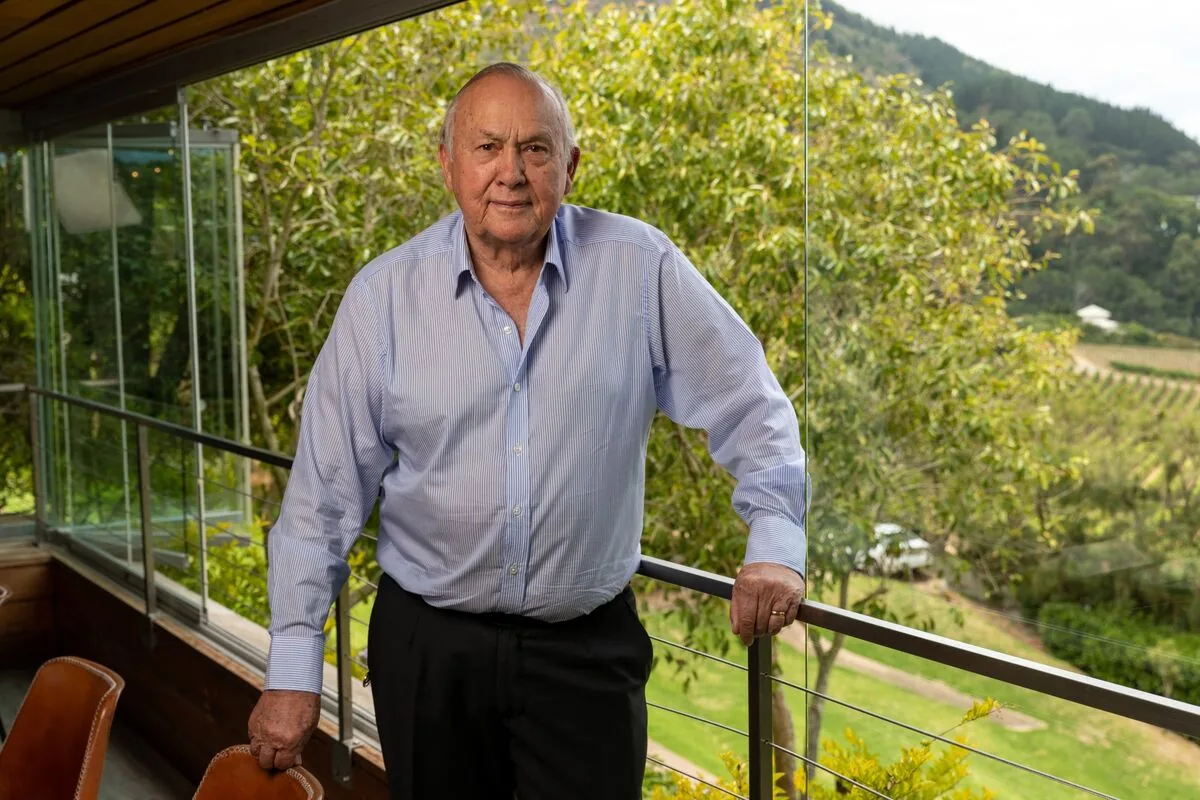
Who Is Clive Calder?
Clive Ian Calder (born 13 December 1946, Johannesburg) is one of the most successful and least-known billionaires to emerge from South Africa. A music industry titan who spent most of his career operating in deliberate anonymity, Calder co-founded the Zomba Group of Companies with Ralph Simon in the early 1970s and built it into the world’s largest independent music operation before selling it to Bertelsmann Music Group (BMG) in 2002 for $2.74 billion — what remains one of the largest independent music deals ever completed.
The crown jewel of Zomba was Jive Records, founded by Calder in 1981, which became a global powerhouse label spanning hip-hop, R&B, teen pop, and rock. At its commercial peak in the late 1990s and early 2000s, Jive’s roster included Britney Spears, the Backstreet Boys, *NSYNC, R. Kelly, A Tribe Called Quest, DJ Jazzy Jeff & The Fresh Prince, and many more. Two-thirds of Jive’s artist roster at the time of the sale had achieved Gold or Platinum status — a record no other label could match.
Despite the scale of his achievement, Calder has maintained an extraordinarily low public profile. He has rarely given interviews, does not appear on red carpets, and relocated to the Cayman Islands after exiting the music industry. His estimated net worth in 2026 is approximately $6.9 billion, placing him among the wealthiest South African-born individuals globally. He is also one of the most significant entrepreneurs that South Africa has ever produced — a fact largely unknown to most South Africans.
“Two-thirds of Jive’s artist roster achieved Gold or Platinum status — a claim no other record label could make at the time of the sale. Calder built the most commercially efficient label in the history of the music business.”
Clive Calder Net Worth in 2026
| Source | Estimated Net Worth | Notes |
|---|---|---|
| Forbes (2026) | ~$6.9B | Real-time billionaires index; global rank ~#555 |
| Bloomberg Billionaires | ~$6–7B | Includes cash equivalents, private equity stakes, gaming investments |
| Celebrity Net Worth | ~$4B | More conservative estimate; widely cited but likely outdated |
| Year-on-Year Change | +$1.2B vs 2024 | Fortune grew from ~$5.7B in 2024 to ~$6.9B in 2026 |
Calder’s wealth is not tied to any publicly traded stock, which makes it harder to track in real time than the fortunes of listed peers like Johann Rupert or Nicky Oppenheimer. Instead, his fortune is held through a private family office and deployed across private equity, gaming ventures, and personal assets. The primary foundation of his wealth remains the $2.74 billion received from the 2002 Zomba sale, which has since compounded through two decades of private investment.
Early Life & South African Roots
Clive Ian Calder was born on 13 December 1946 in Johannesburg, South Africa. Growing up in the city, he developed an early passion for music — playing bass guitar in local bands as a teenager and later working as a talent scout for EMI South Africa. He never attended university, but his instinct for the commercial side of music was evident from a young age.
In 1971, Calder and fellow Johannesburg musician Ralph Simon founded their first music business together in South Africa — a record label, publishing company, and concert promotion outfit that would later be known as CCP Records (Clive Calder Productions), distributed by EMI in South Africa. Their model was a full-service music operation: they were talent spotters, managers, producers, and label executives simultaneously — a 360-degree music business model that was virtually unheard of at the time.
By 1975, Calder and Simon had outgrown the South African market. Their first international client — a young session guitarist and producer named Robert “Mutt” Lange, who would go on to produce AC/DC, Def Leppard, and Shania Twain — convinced them that London was where their ambitions had to be built. They relocated to the UK, rebranded their company as Zomba, and never looked back. Calder has since held dual South African and British citizenship.
Founding Zomba Group in London (1975)
When Calder and Simon arrived in London in 1975, they set up Zomba Group as an artist and producer management company. Their timing was excellent: the British music industry of the mid-1970s was hungry for entrepreneurial operators who understood both the creative and commercial sides of the business. Zomba expanded quickly into music publishing in 1978, opening a New York City office to capture the US market — a crucial early move that would define Calder’s long-term strategy of building a transatlantic music empire from the ground up.
The Zomba model was deliberately structured to give Calder maximum financial control. Rather than simply managing artists, Zomba retained publishing rights, owned recording studios, operated equipment rental businesses, and handled distribution. Every part of the music value chain was owned or controlled by the group — a level of vertical integration that generated compound returns over time that pure label operations could not match.
In 1990, following an unspecified ethical disagreement, Calder bought out Ralph Simon’s entire stake in Zomba, becoming the company’s sole owner. This decision — and the price he paid to achieve it — would prove to be one of the most financially transformative moves in music industry history. Twelve years later, the company Simon had co-founded would sell for $2.74 billion, and Calder would keep almost all of it. As one of the most remarkable entrepreneurial stories in South African business history, it remains largely untold.
Building Jive Records: Hip-Hop to Pop Domination
In 1981, Calder launched Jive Records as a subsidiary label within the Zomba Group. The label’s earliest identity was built on hip-hop and rap music — a genre that major labels had largely dismissed as a passing trend. With the help of newly hired executive Barry Weiss, Jive signed some of the most important early hip-hop acts in history, including DJ Jazzy Jeff & The Fresh Prince (Will Smith’s early career group), Whodini, and A Tribe Called Quest.
The genre credibility Jive built through hip-hop gave the label the reputation to attract acts across multiple categories. Through the late 1980s and 1990s, Jive’s repertoire expanded dramatically. Silvertone Records — a rock and blues subsidiary — launched in 1988. By the mid-1990s, when teen pop exploded globally, Jive was perfectly positioned to capitalise. The label signed the Backstreet Boys, *NSYNC, and, most lucratively of all, Britney Spears — the biggest-selling solo artist of the early 2000s.
What made Jive genuinely exceptional was not just its roster but its conversion rate. Two-thirds of Jive’s signed artists achieved Gold or Platinum certification — a statistic that reflected Calder’s philosophy of signing fewer artists and investing more heavily in each one rather than spreading resources thinly across a large roster. The result was a label that was both commercially efficient and artistically credible across genres — an almost impossible combination to sustain in the music industry.
The Artists Who Built the Empire
| Artist | Genre | Significance |
|---|---|---|
| Britney Spears | Pop | Best-selling female artist of the early 2000s; debut album sold 25M+ copies |
| Backstreet Boys | Teen Pop / Boy Band | One of the best-selling music acts of all time; 130M+ records sold globally |
| *NSYNC | Teen Pop / Boy Band | 70M+ records sold; No Strings Attached (2000) fastest-selling album in history at the time |
| R. Kelly | R&B / Soul | Multiple Grammy-winning artist; among Jive’s highest-selling acts through the 1990s |
| A Tribe Called Quest | Hip-Hop | Foundational hip-hop group; defined Jive’s early genre credibility |
| DJ Jazzy Jeff & The Fresh Prince | Hip-Hop | Grammy-winning rap duo; Will Smith’s first major recording deal |
| Robert “Mutt” Lange | Rock Producer | Zomba’s first international client; produced AC/DC, Def Leppard & Shania Twain |
The $2.74 Billion Sale to Bertelsmann (2002)
In June 2002, Calder agreed to sell the entire Zomba Group of Companies to Bertelsmann Music Group (BMG) for $2.74 billion. The transaction was — and remains — one of the largest deals ever completed in the global music industry. BMG itself was later acquired by Sony Music Entertainment in 2008, which is why Jive Records ultimately became a Sony property before being dissolved into RCA Records in 2011.
What made the sale strategically perfect was its timing. Calder completed the deal at the precise moment when both teen pop and physical CD sales were at their commercial apex. The music industry had not yet been devastated by digital piracy and streaming — that disruption was still a few years away. Selling in 2002 meant Calder captured the full peak valuation of a business that would have been worth considerably less by 2005 or 2008. The decision reflected the same commercial instinct that had defined his career from the beginning.
Because Calder had bought out Simon’s stake in 1990, he received the vast majority of the $2.74 billion sale proceeds directly. After taxes and transaction costs, he walked away with a fortune that — invested conservatively over the following two decades — has grown into the approximately $6.9 billion net worth he holds today. It stands as one of the most successful individual wealth-creation events in South African business history, even though almost none of it happened on South African soil. Compared to the richest South Africans of 2026, Calder’s path is uniquely music-industry in its origin.
Life After Zomba: Investments & Philanthropy
After exiting the music industry in 2002, Calder relocated to the Cayman Islands and adopted a lifestyle of deliberate privacy. He has not given significant public interviews since the sale, has avoided the business press, and manages his fortune through a private family office that shuns public visibility. His wife Patricia and their two children form the core of his personal life. He also holds residency in other jurisdictions and owns significant personal assets, including real estate.
His most notable post-sale investment has been in the gaming sector. In 2018, Calder’s family office and his son Keith’s production company Snoot Entertainment invested approximately $46 million into Cloud Imperium Games — the developer behind the crowdfunded space simulation game Star Citizen. The investment reflected Calder’s long-standing pattern of backing unconventional, high-conviction bets in creative industries.
On the philanthropic side, Calder has channelled significant resources through ELMA Philanthropies, a foundation focused on improving childhood education and healthcare across Africa. He has also donated £1 million to cancer research at Oxford University. His charitable footprint is, like most of his life, deliberately understated — but represents a meaningful commitment to causes that connect back to his African roots. He has been awarded the Order of the British Empire (OBE) for his contributions to the music industry.
Calder vs SA’s Richest: How Does He Compare?
Clive Calder occupies a unique position in the South African wealth landscape. He is the country’s wealthiest individual to have built a fortune primarily in music and entertainment, and his net worth of ~$6.9 billion places him ahead of several of South Africa’s most prominent resident billionaires — including Patrice Motsepe (~$3.9B), Koos Bekker (~$3.5B), and Michiel le Roux (~$3.4B). Yet because he left South Africa in his twenties and built his empire entirely abroad, he does not appear on Forbes Africa’s resident billionaire rankings, and most South Africans have never heard of him.
| Billionaire | Est. Net Worth | Wealth Source | SA Resident? |
|---|---|---|---|
| Johann Rupert | ~$15–16.1B | Richemont (Cartier, IWC) | Yes 🇿🇦 |
| Nicky Oppenheimer | ~$10.6B | De Beers proceeds | Yes 🇿🇦 |
| Clive Calder | ~$6.9B | Zomba / Jive Records | No (Cayman Islands) |
| Patrice Motsepe | ~$3.9B | African Rainbow Minerals | Yes 🇿🇦 |
| Koos Bekker | ~$3.5B | Naspers / Tencent | Yes 🇿🇦 |
| Michiel le Roux | ~$3.4B | Capitec Bank | Yes 🇿🇦 |
His story — like those of Elon Musk and Natie Kirsh — raises an important question about South Africa’s ability to retain and grow entrepreneurial talent. Calder built his empire in London and New York, not Johannesburg. The music industry infrastructure, capital markets, and global distribution networks he needed simply did not exist in South Africa in the 1970s. Whether they exist today for the next generation of South African music entrepreneurs is a debate the country is still having — and one that South Africa’s entrepreneurial community has a stake in answering.