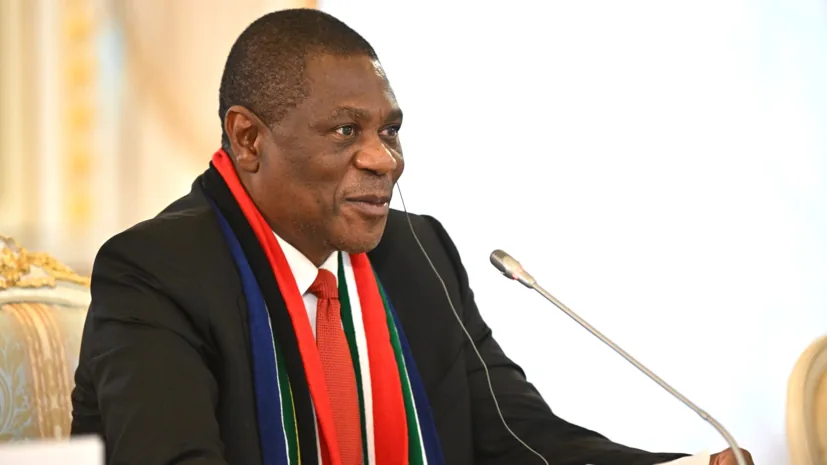
Overview: Who Is Paul Mashatile?
Paulus Shipokosa Mashatile, born on 21 October 1961 in Gerhardsville near Pretoria, is South Africa’s Deputy President and one of the most senior figures in the governing African National Congress (ANC). The son of a domestic worker and a lay priest, Mashatile grew up in Alexandra township, Johannesburg — a community that would shape his politics, his network, and his entire public life. From a child detained without trial during the apartheid state of emergency to the second-highest office in the land, his story is one of extraordinary political ascent.
Mashatile assumed the position of Deputy President of South Africa in March 2023, appointed by President Cyril Ramaphosa following the removal of David Mabuza. He also serves as Deputy President of the ANC, a position he has held since December 2022, and previously served as ANC Treasurer-General from 2017. In the Government of National Unity (GNU) formed after the 2024 general elections, he retains his position as Deputy President — giving him a central role in one of South Africa’s most consequential governing arrangements in decades.
Yet for all his political prominence, it is his personal wealth — its scale, its sources, and the controversies surrounding it — that has dominated public discourse about Mashatile in recent years. His 2025 declaration of two luxury properties worth a combined R65 million, on a salary of approximately R3.16 million per year, sparked a national debate about transparency, political wealth, and the gap between what South Africa’s leaders earn and what they appear to own. For a full picture of where he sits among the country’s wealthiest political figures, see our guide to the richest politicians in South Africa.
Paul Mashatile Net Worth 2026 — The Full Picture
Estimating Paul Mashatile’s net worth with precision is genuinely difficult — and that difficulty is itself part of the story. His official parliamentary disclosures list only a pension fund and an Old Mutual investment policy valued at over R34 million as declared personal assets. No businesses or additional income sources appear in the register. And yet the properties and lifestyle associated with him point to wealth that is far harder to quantify.
Based on credible South African media analysis and public disclosure data as of May 2026, his estimated net worth is approximately R50 million — though some estimates range as high as R54–R55 million when broader asset associations are included. The core components are:
| Asset / Source | Estimated Value | Notes |
|---|---|---|
| Old Mutual Investment Policy | R34M+ | Declared in parliamentary register |
| Constantia Mansion (Cape Town) | R28.9M | Declared 2025; ownership contested (son-in-law’s company) |
| Waterfall Estate (Midrand) | R37M | Attributed to sons and son-in-law; Mashatile declared as beneficiary |
| Additional Properties (Midrand plot, Kelvin home) | ~R3–5M est. | Smaller residential properties declared in earlier registers |
| Pension Fund & Career Savings | Est. R5–8M | Accumulated from 30+ years in senior government roles |
It is important to note that the luxury properties linked to Mashatile are registered in the names of his son-in-law’s companies and his sons — meaning their full value may not translate directly into his personal net worth. The declared R50 million figure reflects conservative estimates of his personally attributable wealth, not the combined value of all family-linked assets. Critics, however, argue that beneficial ownership — not legal title — is the relevant measure, and on that basis the picture is considerably more complex.
His declared Old Mutual investment policy alone exceeds R34 million. Two family-linked luxury properties add a combined R65 million to the broader picture of his household wealth.
Early Life, Activism & Anti-Apartheid Roots
Paul Mashatile grew up in conditions far removed from the luxury properties that now bear his name in parliamentary registers. Raised in Gerhardsville and later Alexandra, he was the child of ordinary working-class parents in a community that lived the harsh realities of apartheid daily. His political awakening came early: he joined the Congress of South African Students (COSAS) in 1976 at the age of fifteen, and by 1980 had become the organisation’s president.
In 1983, Mashatile co-founded and became the first president of the Alexandra Youth Congress (AYC), an organisation aligned with the ANC’s underground structures. He was also a delegate at the launch of the United Democratic Front (UDF) that same year — the broad anti-apartheid coalition that became the most significant internal resistance movement of the 1980s. His activism attracted the attention of the security forces, and during the states of emergency between 1985 and 1989, he was detained without trial. He later went on an 18-day hunger strike while in detention — a detail that has become a regular feature of his political biography and a marker of genuine sacrifice in the liberation struggle.
When the ANC and South African Communist Party (SACP) were unbanned in 1990, Mashatile was among the first to be tasked with rebuilding their legal structures inside the country — particularly in the PWV region (Pretoria-Witwatersrand-Vaal) that would become Gauteng. He was appointed interim regional secretary of the SACP in 1990 and ran the ANC’s political education programme in the region from 1991 to 1992. These organisational roots — built in the heat of the transition — would form the foundation of a political career that spanned more than three decades at senior levels.
Despite the turbulence of those years, Mashatile continued his education through correspondence and part-time study. He obtained a diploma in Economic Principles from the University of London in 1988, a Public Finance and Fiscal Policy certificate from the University of South Africa in 1991, and ultimately a Master’s in Public and Development Management from the University of the Witwatersrand in 1998. These qualifications — earned while he was simultaneously building a political career — reflect a commitment to formal learning that distinguishes him from some contemporaries who came up entirely through the movement.
Political Career: From Alexandra to the Deputy Presidency
Mashatile’s formal political career began in earnest in 1994, when he was elected to the Gauteng provincial legislature in South Africa’s first democratic elections. He became leader of the house in the legislature — a significant position for a 32-year-old — and was appointed Deputy Minister of Arts and Culture in 1996. He resigned from these positions in 1998 to return to Gauteng provincial party structures as ANC Provincial Secretary, and from 2001 onwards served in multiple portfolios in the Gauteng provincial government, including Human Settlements, Transport, Finance, and Economic Development.
In 2008, Mashatile was appointed Premier of Gauteng following the resignation of Mbhazima Shilowa in protest at the ANC’s recall of President Thabo Mbeki. He served as Premier for a brief but significant period until May 2009, when Nomvula Mokonyane succeeded him after the April 2009 general elections. Despite his short tenure, his time as Premier gave him executive experience at the highest provincial level and cemented his standing as one of the most powerful politicians in the country’s wealthiest and most populous province.
Under President Jacob Zuma’s first cabinet (2010–2014), Mashatile served as Minister of Arts and Culture — a national portfolio that raised his profile further. Between 2014 and 2018 he returned to the Gauteng provincial government, serving in several MEC roles. In December 2017, at the ANC’s 54th National Conference in Nasrec — the same conference that elected Cyril Ramaphosa as ANC President — Mashatile was elected ANC Treasurer-General, cementing his place in the party’s top six national officials.
He also served as acting ANC Secretary-General from January 2022, following the step-aside of Ace Magashule. In December 2022, he was elected ANC Deputy President — one of the most powerful positions in the party’s internal hierarchy — and in March 2023 was sworn in as Deputy President of the Republic of South Africa. In this role he serves as Leader of Government Business in Parliament, Chairperson of the South African National AIDS Council (SANAC), and special envoy to South Sudan, among other responsibilities.
“Paul Mashatile’s career is a textbook case of how the ANC builds its leadership: decades of patient organisational work at provincial level, steadily accumulating institutional power and political capital, until the right moment to step onto the national stage arrives.”
Mashatile is widely regarded as one of the most likely successors to President Cyril Ramaphosa when Ramaphosa’s term ends — a prospect that makes the controversies around his personal finances all the more politically significant in 2026.
Salary, Properties & Investment Portfolio
As Deputy President of South Africa, Paul Mashatile earns an annual salary of approximately R3.16 million per year (roughly $170,000 at current exchange rates). This places him comfortably in the top 1% of South African income earners, but it represents a modest base from which to explain the wealth picture that has emerged from parliamentary disclosures and investigative journalism. His declared assets in the parliamentary Register of Members’ Interests include:
Old Mutual Investment Policy — R34 million+. This is the most significant personally declared financial asset on Mashatile’s parliamentary register. An investment policy of this scale, accumulated over decades of senior political service, suggests consistent long-term financial planning. It is notable because it appears in the register as a personal asset — unlike the luxury properties, which are registered in the names of family members’ companies. Financial analysts have noted that a R34 million investment policy is consistent with decades of sustained contributions from a very senior salary, supplemented by returns compounding over time.
Government Pension Fund. Also declared in the register, though no specific valuation has been made public. Given more than three decades at senior levels — multiple cabinet portfolios, two terms as Premier, years as Treasurer-General — the pension entitlement is expected to be substantial.
Residential Property — Kelvin, Johannesburg. A property in Kelvin purchased jointly with his late wife Manzi through a standard bank loan. This is the property Mashatile has most directly acknowledged as his own.
Constantia Mansion (Cape Town) — R28.9 million. A 4,000-square-metre estate in the upscale Constantia suburb of Cape Town. Mashatile lives in the property when Parliament is in session in Cape Town. It was purchased in May 2023 by a company belonging to his son-in-law, Nceba Nonkwelo. Mashatile declared it in his 2025 parliamentary register — two years after his office had denied he owned any Cape Town property.
Waterfall Estate, Midrand — R37 million. A luxury property in one of Gauteng’s most exclusive residential estates. Mashatile has stated that this was purchased jointly by his sons Thabiso and Tinyiko and his son-in-law through a bank loan, and is used as a family residence partly for security reasons.
Combined, these two high-value properties are worth approximately R65 million — more than twenty times Mashatile’s annual salary. The mismatch has attracted intense public scrutiny, with critics and financial commentators questioning how a career public servant’s family came to own assets of this scale.
Controversies: The Constantia Mansion, Hawks Investigation & the “Alex Mafia”
Paul Mashatile’s career has been marked by persistent allegations of corruption and political patronage — allegations he has consistently denied, some of which have been investigated and found unsubstantiated, and others that remain active and unresolved as of 2026.
The Constantia Mansion Declaration (2025). The most significant recent controversy centres on Mashatile’s declaration of a R28.9 million mansion in Constantia, Cape Town, in his June 2025 parliamentary register. The property had been purchased in May 2023 by a company belonging to his son-in-law, Nceba Nonkwelo. For two years, Mashatile’s office publicly denied that he owned any Cape Town property — an October 2024 statement claimed he had no properties in Cape Town except for the Kelvin house purchased with his late wife. The 2025 declaration directly contradicted this position. Mashatile sought to clarify the situation by stating that the house was owned by his son-in-law’s company and that he merely “lived there” — a distinction critics found unconvincing given that he had entered the property in the parliamentary asset register.
The Hawks Investigation. The Hawks — South Africa’s elite crime investigation unit, the Directorate for Priority Crime Investigation — confirmed in late 2025 that an inquiry had been registered into the purchase of the Constantia mansion. Hawks spokesperson Brigadier Thandi Mbambo confirmed that investigators were examining financial records, ownership documents, and mortgage agreements. No charges have been laid against any individual. The Hawks have stated the inquiry is not yet a formal investigation of a specific person. The investigation focuses in part on Nonkwelo, Mashatile’s son-in-law, whose company purchased the property despite reportedly owing approximately R7 million to the Gauteng Partnership Fund for a failed housing development — raising questions about the source of funds used to acquire a R28.9 million asset.
The Diamond Disclosure. Separately, Mashatile acknowledged receiving a diamond from businessman Louis Liebenberg, who was subsequently arrested and is awaiting trial on various criminal charges. The gift was declared in his parliamentary register and has drawn additional scrutiny about his associations with controversial individuals in the private sector.
The Alexandra Renewal Project. Earlier in his career, Mashatile faced allegations that the Gauteng government misused approximately R1.3 billion in funds allocated to the Alexandra Renewal Project — a major urban renewal scheme in Alexandra township that he oversaw as Human Settlements MEC from 1999 to 2004. The matter was the subject of a joint inquiry by the Public Protector and the South African Human Rights Commission. Mashatile appeared before the SAHRC inquiry in November 2019 and denied the allegations, arguing that the R1.3 billion figure referred to projected budgets across multiple government departments over seven years rather than a single allocated and stolen sum. No formal findings of personal wrongdoing were made against him in this matter, and a separate 2006 Gauteng Integrity Commissioner investigation cleared him of impropriety in a related shareholding dispute.
The “Alex Mafia” Label. Mashatile has been associated with what critics and media have called the “Alex mafia” — a network of politically connected individuals with roots in Alexandra township’s anti-apartheid movement who are alleged to have leveraged political relationships for financial gain. He has vigorously denied involvement in any such network. His sons have been reported to have received government tenders from departments previously under his influence, allegations his spokesperson has also denied. The DA laid criminal charges against Mashatile in 2024 relating to alleged corruption, nepotism, and patronage, though no prosecution has followed.
“The core question raised by Mashatile’s financial profile is not whether a career politician can legitimately accumulate wealth — they can. The question is whether the wealth associated with him and his immediate family is consistent with any plausible combination of salary, legitimate business activity, and investment returns. Critics argue it is not. Mashatile argues it is. As of 2026, the truth remains disputed.”
Personal Life: Wives, Children & The Manzi Mashatile Foundation
Paul Mashatile married Manzi Ellen Mashatile in 1986. They had two children together: a daughter, Palesa, and a son, Thabiso. Manzi was a teacher and community activist who supported her husband’s political career throughout the decades of his ascent. She died in 2020 after a long illness. Her death was a significant personal loss for Mashatile, who has spoken publicly about her influence on his life and values.
In honour of her legacy, Mashatile established the Manzi Mashatile Foundation in 2020 — a charitable organisation focused on providing educational opportunities for underprivileged youth. The foundation reflects a recurring theme in Mashatile’s public persona: a commitment to social upliftment rooted in the struggles of the community where he grew up. Critics have noted the irony of a politician under scrutiny for unexplained wealth simultaneously running a charitable foundation in his late wife’s name, but supporters argue the two are entirely separate matters.
In 2023, Mashatile married Hlumile Mjongile, a former ANC Youth League leader and a Member of Parliament. The second marriage drew some public commentary — partly because the newly married couple moved into the Constantia mansion purchased by Mashatile’s son-in-law Nceba Nonkwelo, who is married to his daughter Palesa from his first marriage. Mashatile is also a member of the Zion Christian Church (ZCC) and has described his faith as an important part of his identity.
His sons Thabiso and Tinyiko have both been named in media reports about government tenders linked to departments previously under Mashatile’s oversight — allegations his office has denied. Son-in-law Nceba Nonkwelo, who purchased the Constantia mansion, is reportedly under investigation by the Hawks in connection with that transaction and his related financial dealings with the Gauteng Partnership Fund.
How Does He Compare? SA’s Richest Politicians 2026
In the context of South Africa’s wealthiest politicians, Paul Mashatile occupies a middle tier — significantly less wealthy than the BEE-era billionaires at the top of the list, but substantially wealthier than a typical career politician whose assets reflect salary alone. For a full breakdown of all ten rankings, see our comprehensive guide to the richest politicians in South Africa 2026.
| Rank | Politician | Est. Net Worth | Primary Wealth Source |
|---|---|---|---|
| #1 | Cyril Ramaphosa | ~$450M (≈R8.3B) | BEE — Shanduka Group, Bidvest, MTN |
| #2 | Tokyo Sexwale | ~$200M (≈R3.7B) | BEE — Mvelaphanda, diamonds, gold |
| #3 | Pravin Gordhan | ~$35M (≈R647M) | Property, career savings, directorships |
| #4 | Julius Malema | ~$30M (≈R554M) | Contested — trusts, tenders, property |
| #5 | Gwede Mantashe | ~$25M (≈R462M) | Mining interests, union pension structures |
| #9 | Paul Mashatile | ~R50M (≈$2.7M) | Old Mutual policy, property, salary savings |
What distinguishes Mashatile from the wealthiest politicians on the list is the absence of a clearly identified legitimate business vehicle — no Shanduka Group equivalent, no identified BEE transaction, no mining stake or large corporate directorship. The wealth attributed to him is built on a long career salary, a substantial investment policy, and properties associated with family members. That combination is not inherently suspicious. But the scale of the properties relative to any plausible accumulation from salary and investment — and the initial failure to disclose the Constantia property — has made his financial profile one of the most scrutinised in South African public life as of 2026.