Overview: Political Wealth in South Africa in 2026
South African politics and big money have been intertwined since the end of apartheid — and in 2026, the country’s wealthiest politicians represent a fascinating cross-section of liberation-era deal-making, post-1994 Black Economic Empowerment (BEE) windfalls, family business empires, and, in some cases, deeply contested sources of wealth that have been the subject of state capture inquiries and public scrutiny.
The list of the richest politicians in South Africa is dominated — though not exclusively — by senior ANC figures who were positioned to benefit from the landmark BEE transactions of the early 2000s. These deals, negotiated during the Thabo Mbeki era, transferred significant stakes in major South African corporations to previously disadvantaged individuals, creating a new class of politically connected business elites overnight. Cyril Ramaphosa, now the country’s president, is the most prominent example — his Shanduka Group investments in the early 2000s laid the foundation for a personal fortune estimated at approximately $450 million, making him not just the richest politician in South Africa but one of the wealthiest heads of state on the African continent.
“South Africa’s wealthiest politicians built their fortunes not through political salaries — which are substantial but not exceptional — but through BEE transactions, mining rights, business directorships, and in some cases, the kind of access-to-power that generates wealth through channels that are difficult to trace.”
A note on methodology: politician net worth in South Africa is notoriously difficult to verify. Members of Parliament are required to disclose their financial interests in the parliamentary register, but these disclosures list categories of assets — properties, shareholdings, business interests — rather than valuations. The figures in this article are drawn from Forbes Africa, Sunday Times Rich List, Bloomberg, and credible South African investigative journalism, cross-referenced across sources. Where figures differ, we use conservative mid-range estimates and note the uncertainty clearly. South African readers should also be aware that for some politicians on this list — particularly those implicated in state capture — sources of wealth are contested and subject to ongoing legal proceedings.
Full Rankings: Top 10 Richest South African Politicians (May 2026)
The table below ranks South African politicians — current and recently active — by estimated net worth as of May 2026. Rankings reflect known business interests, BEE shareholdings, property portfolios, and credible published estimates. Political salary alone accounts for a small fraction of the wealth of everyone on this list.
| Rank | Politician | Est. Net Worth | Party / Role |
|---|---|---|---|
| #1 | Cyril Ramaphosa | ~$450M (≈R8.3B) | ANC — President of South Africa |
| #2 | Tokyo Sexwale | ~$200M (≈R3.7B) | ANC — Former Gauteng Premier & Minister |
| #3 | Pravin Gordhan | ~$35M (≈R647M) | ANC — Former Finance Minister |
| #4 | Julius Malema | ~$30M (≈R554M) | EFF — Party Founder & CIC |
| #5 | Gwede Mantashe | ~$25M (≈R462M) | ANC — Mineral Resources & Energy Minister |
| #6 | John Steenhuisen | ~$10M (≈R185M) | DA — Party Leader & Deputy PM |
| #7 | Ace Magashule | ~$8M (≈R148M) | ANC (suspended) — Former Secretary-General |
| #8 | Mmusi Maimane | ~$7M (≈R129M) | Independent — Former DA Leader |
| #9 | Paul Mashatile | ~$6M (≈R111M) | ANC — Deputy President of South Africa |
| #10 | Lindiwe Sisulu | ~$5M (≈R92M) | ANC — Former Cabinet Minister |
His fortune was built primarily through the Shanduka Group and early BEE stakes in companies including Bidvest, MTN, and Macsteel — long before he returned to full-time politics.
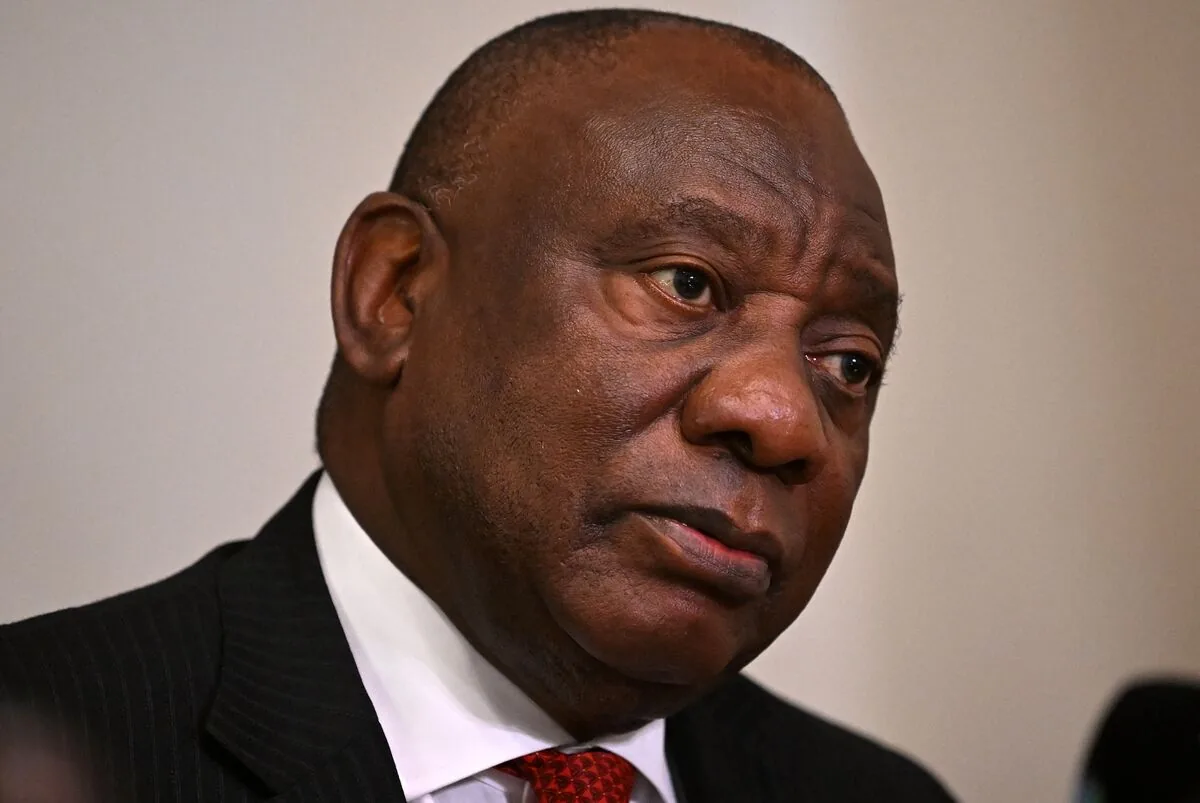
#1 Cyril Ramaphosa — South Africa’s Richest President (~$450M)
Born on 17 November 1952 in Soweto, Matamela Cyril Ramaphosa is South Africa’s fifth post-apartheid president and by a considerable margin its wealthiest. His estimated net worth of approximately $450 million (≈ R8.3 billion) places him not just at the top of the political wealth rankings in South Africa, but among the wealthiest heads of state on the entire African continent. Yet the most remarkable aspect of Ramaphosa’s fortune is that nearly all of it was made not during his time in political office, but during a deliberate withdrawal from frontline politics between 1996 and 2012 — a period in which he transformed himself from a union leader into a business billionaire.
Ramaphosa’s wealth is rooted in the founding of Shanduka Group in 2001 — an investment holding company that became a vehicle for some of the most valuable Black Economic Empowerment transactions in South African corporate history. Through Shanduka, Ramaphosa acquired stakes in Bidvest Group, MTN, Macsteel, Standard Bank, McDonald’s South Africa, Coca-Cola Beverages South Africa, and several other major corporations. His stake in Bidvest alone was worth hundreds of millions of rands at various points. Shanduka was eventually merged with Pembani Group in 2014, further consolidating and diversifying his wealth.
Perhaps the most publicly known — and controversial — element of Ramaphosa’s business legacy is his investment in Lonmin Platinum, where he held a non-executive directorship at the time of the Marikana massacre in 2012, in which 34 striking mineworkers were killed by police. A Shanduka-linked email in which Ramaphosa called for “concomitant action” against striking workers became a serious point of controversy during his 2017 ANC presidential campaign. Ramaphosa has consistently defended his position and the Farlam Commission found that he bore no criminal responsibility.
Since returning to full-time politics — first as ANC Deputy President in 2012, then as South Africa’s President from February 2018 — Ramaphosa has placed his business interests in a blind trust. His presidential salary of approximately R3.9 million per year (≈ $210,000) is significant but represents a small fraction of his overall wealth. The Phala Phala farm scandal of 2022 — in which millions of US dollars in cash were reportedly concealed in his game farm following a theft — drew further public attention to the scale of his personal financial holdings.
#2 Tokyo Sexwale — The Mining Magnate (~$200M)
Mosima Gabriel “Tokyo” Sexwale, born on 5 March 1953 in Soweto, is one of the most storied figures in South African political and business life — a former Robben Island prisoner alongside Nelson Mandela, a liberation hero, Gauteng’s first Premier after apartheid, and ultimately one of the most successful mining entrepreneurs the country has produced. His estimated net worth of approximately $200 million (≈ R3.7 billion) reflects a business empire built almost entirely after 1994, when he transitioned from politics into private enterprise with the energy that characterised everything he did.
Sexwale founded Mvelaphanda Group, which became one of the most significant black-owned holding companies in South African business history, building significant stakes in Trans Hex Group (diamonds), Gold Fields, and a variety of resources and energy assets. His diamond trading interests alone generated extraordinary wealth during a period of rising commodity prices in the 2000s. He served as Minister of Human Settlements under Jacob Zuma from 2009 to 2014 before departing politics to focus on his business interests.
Sexwale gained an entirely different kind of international recognition when he appeared on the American reality television series The Apprentice: Celebrity Edition, bringing his profile to a global audience. His wealth, his charisma, and his political history make him one of the most genuinely fascinating figures in South African public life. A failed bid for the FIFA presidency in 2015 added yet another chapter to a biography that reads more like a novel than a career. His net worth has fluctuated with commodity markets and the rand, but he remains one of the country’s most substantial individual wealth holders.
#3 Pravin Gordhan — The Technocrat’s Wealth (~$35M)
Pravin Jamnadas Gordhan, born 12 April 1949 in Durban, is the politician most South Africans associate with fiscal discipline, institutional integrity, and resistance to state capture — a reputation earned through two tenures as Finance Minister (2009–2014 and 2017–2018) and a turbulent period as Minister of Public Enterprises during which he oversaw the partial stabilisation of Eskom and other SOEs. His estimated net worth of approximately $35 million (≈ R647 million) is notable not for its scale — modest by the standards of this list — but for its sources, which are largely seen as clean: career savings, property investments, and income from legitimate business directorships.
Gordhan spent the bulk of his career as a public servant and ANC underground operative, which limited his exposure to the BEE deal-making that enriched many of his contemporaries. His later wealth came through property investments in Gauteng and KwaZulu-Natal, a pension from decades of public service, and a small number of private sector board roles he took up after leaving active cabinet positions. He was a target of sustained political attacks from Jacob Zuma’s allies during the state capture years and was notably subjected to a controversial SARS “rogue unit” investigation — charges that were eventually withdrawn and widely attributed to political interference. His reputation as one of the more financially ethical figures in top South African politics contributes to why his wealth, though far smaller than Ramaphosa’s (~$450M), attracts far less scrutiny.
#4 Julius Malema — The EFF’s Controversial Millions (~$30M)
Julius Sello Malema, born 3 March 1981 in Seshego, Limpopo, is without question South Africa’s most polarising political figure — and his personal wealth is among the most debated topics in the country’s public discourse. The founder and Commander-in-Chief of the Economic Freedom Fighters (EFF), Malema built his movement on radical economic transformation, expropriation without compensation, and fierce criticism of the ANC elite’s accumulation of wealth. The irony that his own estimated net worth sits at approximately $30 million (≈ R554 million) is not lost on his critics — or, increasingly, on his own supporters.
Malema’s wealth is the subject of ongoing legal scrutiny. The South African Revenue Service (SARS) has pursued him over disputed tax liabilities, and various investigations have probed the role of a trust structure — the On-Point Engineering trust — through which construction contracts were allegedly channelled during his time as president of the ANC Youth League. Properties in Sandton, a farm in Limpopo, and a reported lifestyle that includes luxury vehicles and overseas travel have all attracted scrutiny relative to his declared income as a sitting Member of Parliament.
Malema’s defenders argue that many of the assets attributed to him are not personally owned or have been exaggerated by political opponents. His critics point to the On-Point Engineering contracts — government tenders worth tens of millions of rands in Limpopo — as the foundation of wealth that cannot be explained by any conventional political salary or legitimate business income. The full picture remains genuinely contested, making Malema’s position on this list the most uncertain of any top-five entry. What is beyond dispute is that he lives the lifestyle of a very wealthy man — and that his wealth has become as defining a feature of his political story as any policy position he holds.
#5 Gwede Mantashe — ANC Veteran & Mining Interests (~$25M)
Gwede Mantashe, born 21 June 1956 in Ngqeleni, Eastern Cape, has been one of the most powerful figures in South African politics for the better part of three decades — former General Secretary of the National Union of Mineworkers (NUM), former ANC Secretary-General, and currently Minister of Mineral Resources and Energy under President Ramaphosa. His estimated net worth of approximately $25 million (≈ R462 million) is built on decades of senior trade union and political income, property investments, and a number of business directorships held over the years.
Mantashe’s financial profile attracted significant attention in 2018 when it emerged that his properties — including a farm in the Eastern Cape — had allegedly been under surveillance by a private company with links to the Gupta family. The episode raised questions about his proximity to interests that were under investigation as part of the broader state capture inquiry. Mantashe has consistently denied wrongdoing and has maintained his position in cabinet through successive Ramaphosa administrations. His mining portfolio interests — both through union pension fund structures he was involved with at NUM and through personal investments — are the largest individual contributors to his estimated net worth. His continued ministerial role in the energy and minerals sector keeps him at the intersection of South African politics and one of its most lucrative economic sectors.
#6–#10: Steenhuisen, Magashule, Maimane, Mashatile & Sisulu
John Steenhuisen (~$10M) — The Opposition’s Leading Voice
John Henry Steenhuisen, born 19 March 1976 in Durban, is the leader of the Democratic Alliance (DA) and one of the most prominent opposition politicians in South Africa. Since the formation of the Government of National Unity (GNU) in 2024, Steenhuisen has served as Deputy Prime Minister — a historic moment for the DA, marking the party’s first senior executive role in national government since the post-apartheid transition. His estimated net worth of approximately $10 million (≈ R185 million) is built on a career in formal politics supplemented by directorships, property investments in KwaZulu-Natal and Gauteng, and the financial stability that comes from senior parliamentary positions over more than two decades. Unlike many ANC-aligned politicians on this list, Steenhuisen’s wealth has not attracted public controversy — he is seen as a career politician whose assets reflect legitimate accumulation rather than access to government procurement.
Ace Magashule (~$8M) — The Suspended Powerbroker
Elias Sekgobelo “Ace” Magashule, born 14 February 1959 in Parys, Free State, served as Premier of the Free State for a decade and as ANC Secretary-General until his suspension from the party following corruption charges related to a R255 million asbestos audit contract in the Free State. His estimated net worth of approximately $8 million (≈ R148 million) is heavily scrutinised — the Zondo Commission implicated him in widespread state capture networks in the Free State, and the corruption case against him, relating to the appointment of a company owned by political associates for the asbestos work, remains one of the most closely watched legal proceedings in South African politics. His wealth, derived from decades as one of the most powerful political operators in the country, reflects the kinds of access and influence that made him both enormously powerful and enormously controversial.
Mmusi Maimane (~$7M) — The Reinvented Voice
Mmusi Aloysias Maimane, born 6 June 1980 in Dobsonville, Soweto, served as leader of the Democratic Alliance from 2015 to 2019 before resigning and eventually establishing himself as an independent political voice through the Build One South Africa (BOSA) movement. His estimated net worth of approximately $7 million (≈ R129 million) reflects income from a career in politics, pastoral ministry, public speaking, and a growing media and entrepreneurial profile. Maimane is one of the more commercially active politicians in South Africa — he has a significant social media following, a podcast, speaking circuit income, and brand associations. His trajectory from party leader to independent intellectual and media figure mirrors paths taken by political figures internationally who find commercial and public-voice opportunities after frontline party politics.
Paul Mashatile (~$6M) — The Deputy President
Paul Shipokosa Mashatile, born 31 October 1961 in Alexandra township, Johannesburg, is South Africa’s Deputy President under Cyril Ramaphosa — a position he has held since 2023 following the removal of David Mabuza. A longstanding ANC figure with deep roots in Gauteng politics, Mashatile served as Gauteng Premier from 2008 to 2009 and as ANC Treasurer-General before his appointment to the deputy presidency. His estimated net worth of approximately $6 million (≈ R111 million) reflects a career of seniority in both provincial and national government, supplemented by investments in property and the kinds of business relationships that senior ANC figures have historically cultivated. His financial profile is relatively modest by the standards of the top of this list — a reflection, perhaps, that his rise to power was rooted in organisational ANC politics rather than the BEE deal-making that enriched Ramaphosa (~$450M) and Sexwale (~$200M).
Lindiwe Sisulu (~$5M) — The ANC Dynasty
Lindiwe Nonceba Sisulu, born 10 May 1954 in Orlando, Soweto, is the daughter of ANC struggle stalwart Walter Sisulu and Albertina Sisulu — making her part of the closest thing South Africa has to a political dynasty. She has served in multiple cabinet positions across successive ANC administrations, including as Minister of Defence, Minister of Human Settlements, Minister of International Relations, and Minister of Tourism. Her estimated net worth of approximately $5 million (≈ R92 million) reflects the accumulated financial position of a lifelong politician from an elite liberation-movement family, supplemented by property investments and the benefits of decades of senior cabinet income. Sisulu made headlines in early 2022 when she published a widely-read opinion piece criticising the judiciary and the Constitution — a moment that briefly made her a major political topic and indicated that, despite her seniority, she remained willing to court controversy.
How South African Politicians Build Their Wealth
The wealth of South African politicians is built through a relatively small number of well-understood pathways — some legitimate and widely accepted, others deeply contested. Understanding these mechanisms is important context for anyone reading a list like this.
1. BEE Transactions (The Big One). The Black Economic Empowerment deal-making of the early 2000s created more political wealth in South Africa than any other single mechanism. Under BEE legislation, major corporations were required or strongly incentivised to transfer significant equity stakes to previously disadvantaged individuals. The politicians and liberation-era figures who were best-positioned to receive these stakes — Ramaphosa (~$450M), Sexwale (~$200M), and dozens of others — became extremely wealthy very quickly. These transactions were legal, intentional government policy, and politically uncontroversial at the time. Their legacy is more contested today, as critics argue they enriched a small political elite without meaningfully transforming the broader economy.
2. Senior Salary Accumulation. A South African cabinet minister earns approximately R2.5–R3.9 million per year. A Member of Parliament earns approximately R1.4 million per year. These are significant salaries — roughly in the top 1% of South African income earners — and over decades of service they compound meaningfully, particularly when combined with pension benefits and medical aid provisions. Politicians who have served for 20–30 years at senior levels accumulate legitimate wealth from salary alone, supplemented by investments made from that income.
3. State Contracts & Tender Relationships. The most contested source of political wealth in South Africa — one that the Zondo Commission spent years documenting in forensic detail — involves the relationships between politicians, their families, associates, and the award of government contracts. The state capture era, centred on the Jacob Zuma presidency (2009–2018), saw an extraordinary looting of state-owned enterprises and government departments. Several politicians on this list — including Ace Magashule (~$8M) and Julius Malema (~$30M) — have been implicated to varying degrees in these networks, and in some cases legal proceedings are ongoing.
4. Property and Business Investments. Many senior South African politicians — particularly those who entered politics from professional backgrounds or the trade union movement — have made meaningful property investments over the years. South African residential property in Sandton, the Atlantic Seaboard, and certain KwaZulu-Natal and Eastern Cape markets has provided strong returns over the past 20 years, creating legitimate wealth for those who bought early and held.
“The defining feature of South African political wealth is how quickly it can be created. A politician who was a union organiser in 1994 could, through a single well-timed BEE transaction a decade later, become wealthier than most South Africans will ever be. The speed of that transformation — and its concentration in a small network — is the central story of wealth and politics in post-apartheid South Africa.”