Siphiwe Tshabalala Net Worth 2026 — Overview
Siphiwe Tshabalala’s net worth in 2026 is estimated at approximately $5 million, equivalent to roughly R92 million at current exchange rates. Known to all of South Africa simply as Shabba, Tshabalala occupies a unique position in the country’s sporting and cultural landscape: he is not merely one of the richest footballers South Africa has produced, but arguably the single most iconic figure in the history of South African sport — the man who, on 11 June 2010, scored the first goal of the FIFA World Cup on home soil, a moment that stopped an entire nation in its tracks and was watched by an estimated 530 million television viewers worldwide. That one moment, more than any salary figure or endorsement deal, defined the commercial ceiling of his career and ensured that his name, face, and story would remain commercially valuable for decades beyond his retirement.
His wealth was accumulated across a 16-year professional career anchored primarily at Kaizer Chiefs — South Africa’s most supported club and one of the continent’s wealthiest — supplemented by stints in Turkey with Bursaspor and in Saudi Arabia with Al-Qadsiah, both of which provided earnings substantially above what was available in the PSL at the time. Beyond his football wages, Tshabalala built meaningful commercial income through long-term partnerships with Nike, Vodacom, and MTN, three of the largest brands operating in South African sport. His post-career income streams — media work, brand ambassadorship, motivational speaking, and business investments in Johannesburg — have kept his financial position strong well into retirement, which he announced in 2021 after a final season back at Kaizer Chiefs.
For context on where his net worth places him among his peers, see the 99 Hustle ranking of the richest soccer players in South Africa 2026.
That goal generated endorsement leverage, speaking fees, and brand ambassador income that extended Tshabalala’s commercial value far beyond what any domestic football salary could have produced on its own.
Early Life & Background
Siphiwe Tshabalala was born on 23 September 1984 in Kagiso, a township in the Mogale City Local Municipality of Gauteng, located west of Johannesburg on the edge of the West Rand. Growing up in one of Gauteng’s larger townships during the late apartheid and early post-apartheid era, Tshabalala was raised in circumstances that, like so many of South Africa’s finest footballers, were modest at best. He developed his skills playing informal street football in Kagiso before being identified by local football structures that fed into the organised youth development pipelines that would eventually carry him to professional football. His family — particularly his parents, who instilled in him a strong work ethic — have been cited in multiple interviews as the foundation of a personal discipline that set him apart from peers of equal raw talent who did not make it to the highest level.
He attended school in the Kagiso area and progressed through local youth football before being picked up by Kaizer Chiefs’ youth academy structures — one of the most organised and well-resourced development systems in South African football. His time in the Chiefs academy produced a technically complete left-sided player with exceptional pace, a powerful left foot, and an ability to cut inside or deliver from wide positions that made him one of the most dangerous wide attackers of his PSL generation. He made his senior debut for Chiefs in the 2004-05 season at the age of 20, beginning a one-club association that would define the first chapter of his career and produce the most famous moment in South African sporting history just six years later.
Football Career: Chiefs, Turkey, Saudi Arabia & Retirement
Tshabalala’s professional career began at Kaizer Chiefs in the 2004-05 PSL season. Over the following decade at Naturena, he became one of the most beloved players in the club’s history — a distinction that carries enormous weight at a club with over 16 million supporters across South Africa. His pace, directness, and thunderous left foot made him a crowd favourite from his earliest senior appearances, and his consistency over multiple seasons earned him recognition as one of the best wide players in the PSL at his peak. During his first Chiefs tenure, he won multiple domestic honours including the Nedbank Cup, MTN 8, and Telkom Knockout across different seasons, contributing to a period of strong domestic performance under coaches including Muhsin Ertuğral and Stuart Baxter.
His career’s defining chapter came at the 2010 FIFA World Cup — see the dedicated section below — after which his profile and commercial value were fundamentally transformed. In 2012, Tshabalala made his first overseas move, joining Bursaspor in Turkey’s Süper Lig. His time in Turkey was significant financially, with Süper Lig wages of the era representing a meaningful step up from PSL earnings, and commercially, as his post-World Cup profile ensured he arrived in Europe as a recognisable name rather than an unknown quantity. He made 41 appearances for Bursaspor across two seasons before returning to South Africa.
His next overseas venture took him to Al-Qadsiah in Saudi Arabia’s first division — a move that again prioritised financial remuneration, with Saudi Arabian football wages of the era offering figures substantially above both PSL and Turkish equivalents for a player of his profile. Saudi football’s investment model, particularly in its lower tiers at that time, attracted several African players with established continental profiles. Tshabalala’s Saudi stint added further to his career earnings base before he returned to South Africa for his final chapter.
He rejoined Kaizer Chiefs in 2018 for what would become the sentimental final chapter of his career — a return to the club where he had started, in front of the supporters who had always claimed him as their own. He made his final competitive appearances for Chiefs during the 2020-21 season, which was conducted under COVID-19 protocols in a bio-bubble with no supporters in stadiums — a bittersweet circumstance that denied him the farewell crowd he deserved. He officially retired in 2021, ending a 16-year professional career that produced 98 Bafana Bafana caps and 11 international goals — a caps tally that makes him one of the most-capped players in South African football history. His overall career record included over 350 professional appearances, 45+ goals, and a trophy cabinet that spans domestic cups, league medals, and an African Cup of Nations semifinal run with Bafana Bafana in 2019.
His career honours include: Nedbank Cup (2009, 2018 with Chiefs), MTN 8 (2013 with Chiefs), Telkom Knockout (2013 with Chiefs), and an AFCON 2019 semifinal appearance with Bafana Bafana — their best tournament finish in years. He was named PSL Player of the Season in 2009-10 and received the South African Football Writers’ Footballer of the Year award in 2010 following the World Cup, recognitions that reflected a career operating at the absolute summit of the domestic game.
The Goal That Stopped the World — 2010 FIFA World Cup
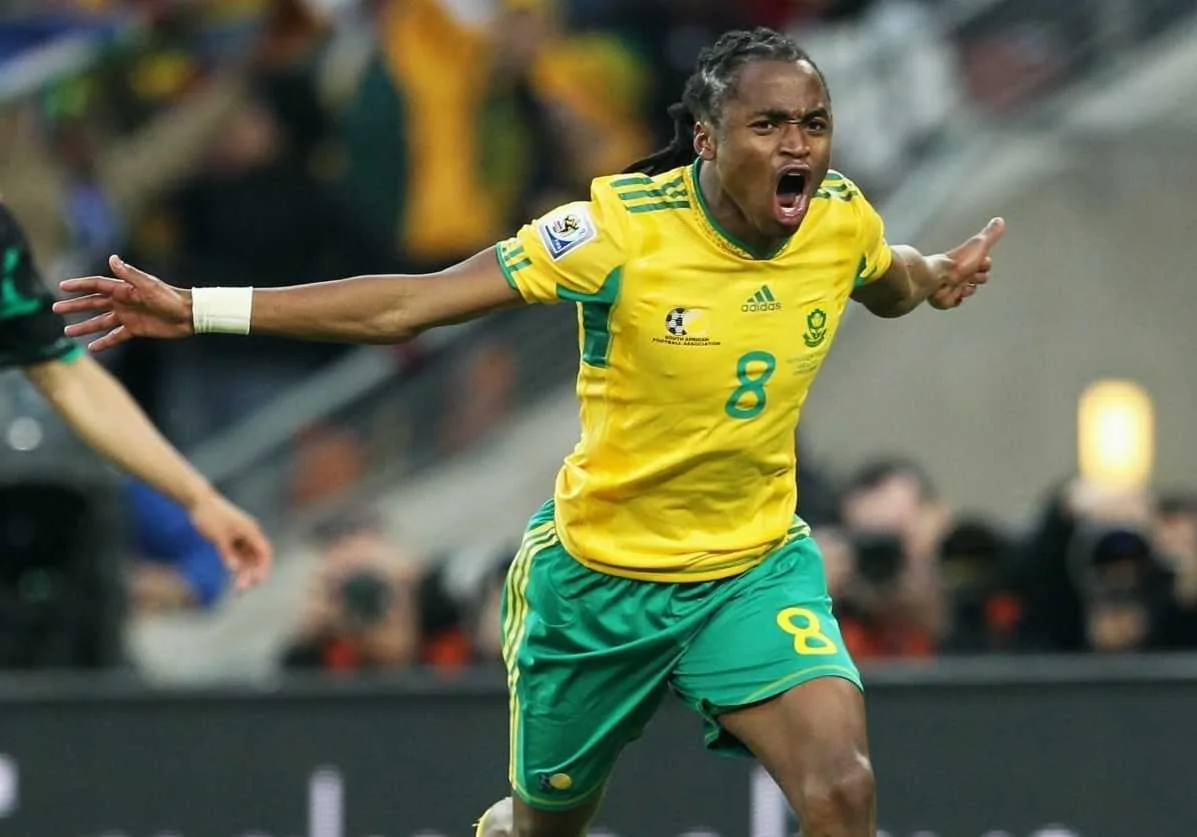
On 11 June 2010, at Soccer City (now FNB Stadium) in Johannesburg, Siphiwe Tshabalala received the ball on the left flank in the 55th minute of South Africa’s opening match against Mexico in Group A of the FIFA World Cup. What happened in the next two seconds — a cut inside, a shift onto his favoured left foot, and a ferocious curling strike into the far top corner — produced the single most watched and replicated moment in South African sporting history. It was the first goal of the first FIFA World Cup held on African soil, scored by a South African, in front of 84,490 fans inside the stadium and an estimated 530 million television viewers globally.
The commentary that accompanied the goal — Martin Tyler’s roar on ITV, the Zulu and Sesotho exclamations on SABC, the collective explosion of sound from South Africa’s fan parks — became embedded in the country’s cultural memory in a way that transcends sport. In a nation where the scars of apartheid were still raw, where football had been used as a tool of unity during the transition era, and where hosting the World Cup was understood as an affirmation of South Africa’s place in the world, that goal carried a symbolic weight that no financial figure can adequately capture. Tshabalala did not simply score a goal; he gave a country a moment it had been waiting for.
The commercial consequences were immediate and lasting. Every major South African brand that was not already associated with him made approaches in the weeks following the goal. His existing partnerships with Nike, Vodacom, and MTN were renewed on upgraded terms. He was invited to address corporate audiences, government functions, and youth football programmes. International media requests came from across Europe, the Americas, and Asia. The goal made him the most commercially valuable South African footballer of his era by a distance — and the residual brand equity of that moment has continued to generate income for him well into his retirement years in 2026, through speaking engagements, brand ambassador renewals, documentary appearances, and commemorative events marking the anniversary of the 2010 World Cup.
“When I scored that goal I didn’t think about anything — I just celebrated. But afterwards, I realised it wasn’t just about me or the team. It was about what South Africa needed in that moment. That goal belonged to all of us.” — Siphiwe Tshabalala, speaking to SuperSport, 2020
Salary Breakdown: What Siphiwe Tshabalala Earned Per Club
Tshabalala’s career earnings came from three distinct phases: his long domestic tenure at Kaizer Chiefs (across two stints), his overseas ventures in Turkey and Saudi Arabia, and his post-career commercial activity. The figures below are compiled from Briefly.co.za, Entrepreneur Hub SA, Capology, and Owogram, and represent the most credible published estimates. Precise figures were never publicly confirmed by the clubs or Tshabalala himself.
| Club | Period | Est. Monthly Salary | Notes |
|---|---|---|---|
| Kaizer Chiefs (First Stint) | 2004–2012 | ~R80,000–R500,000 | Grew from entry-level to one of Chiefs’ highest earners; 2010 World Cup goal transformed salary leverage; multiple domestic cup wins |
| Bursaspor (Turkey — Süper Lig) | 2012–2014 | ~€25,000–€35,000 (≈R400K–R600K at time) | 41 appearances; first overseas earnings; Süper Lig wages significantly above PSL equivalents; post-World Cup profile assisted contract negotiation |
| Al-Qadsiah (Saudi Arabia) | 2014–2016 | ~R400,000–R700,000 (est.) | Saudi first division; lucrative contract reflecting Gulf football’s spending model; exact figures undisclosed |
| Kaizer Chiefs (Return) | 2018–2021 | ~R300,000–R450,000 | Sentimental homecoming; senior squad role; final competitive season played behind closed doors due to COVID-19; retired 2021 |
The overseas chapters are the most significant financial multiplier in Tshabalala’s career earnings picture. His Turkey and Saudi Arabia stints, combined with the post-2010 uplift in his Kaizer Chiefs contract value, produced a cumulative gross earnings trajectory across his 16-year career that Entrepreneur Hub SA estimates at well over R50 million before taxes and agent fees. Combined with his substantial commercial income — detailed in the endorsements section — and his property and investment base, this supports a net worth figure at the $5 million mark as a realistic and defensible estimate for 2026.
Endorsements & Commercial Income
Tshabalala’s endorsement portfolio has always been the most impressive of any South African footballer of his generation — a status earned not simply through on-field excellence, but through the unparalleled cultural resonance of the 2010 World Cup goal. His most prominent and long-running brand relationships have been with Nike, which sponsored him as a personal athlete beyond his clubs’ kit deals; Vodacom, South Africa’s largest mobile network operator; and MTN, which leveraged his status as a national icon for multiple major campaigns across different phases of his career. These three partnerships alone — the most prestigious brand portfolio assembled by any South African PSL player of the era — generated income streams that Entrepreneur Hub SA estimates at between R30,000 and R80,000 per appearance or campaign execution, with retainer arrangements adding consistent annual income on top.
Beyond those headline partnerships, Tshabalala was associated with a range of South African consumer and lifestyle brands across beverages, financial services, and sportswear. His post-retirement life has included substantial income from corporate motivational speaking — addressing audiences at blue-chip South African companies, government leadership programmes, and youth development conferences — where his story of growing up in Kagiso and scoring the most iconic goal in South African sporting history provides one of the country’s most compelling narratives of talent, hard work, and national pride. Entrepreneur Hub SA places his speaking appearance fee at between R50,000 and R150,000 per engagement depending on the event profile and format.
He has also remained commercially active through television and media appearances, including punditry on SuperSport and SABC Sport, documentary participation, and commemorative content produced around the anniversaries of the 2010 World Cup. In 2026 — which marks the 16th anniversary of the goal and sits in the build-up global attention cycle toward the 2030 FIFA World Cup — his media and ambassadorial activity has remained elevated. His Instagram and X (Twitter) platforms maintain active followings that continue to attract brand partnership approaches, and his careful stewardship of his public image throughout retirement has preserved the commercial value of an association that lesser-managed athletes often squander in the years following peak fame.
Property & Assets: House, Cars and Investments
Tshabalala’s primary residence is a luxury home in Johannesburg, reported by Entrepreneur Hub SA and Briefly.co.za to be valued at approximately R12–15 million — a property befitting one of South Africa’s most recognisable public figures and reflecting the peak earning power of a footballer who commanded top-tier domestic and overseas wages across 16 professional years. He is also reported to hold additional property investments in the greater Johannesburg metropolitan area, consistent with a real estate strategy that several South African sports personalities have pursued as a hedge against the volatility of football income. His post-career financial discipline has been regularly cited as an example for younger players navigating the transition from athlete to private investor.
His vehicle collection is among the best-documented and most admired of any retired South African footballer. Confirmed vehicles include a Mercedes-Benz G-Class (G63 AMG) — valued at approximately R3.5 million — a Porsche Cayenne (approximately R1.8 million), and a Range Rover Autobiography (approximately R2.2 million). Briefly.co.za estimates his total vehicle collection at over R8 million, making it one of the most valuable car collections associated with any South African PSL player or retired footballer. His car choices reflect a preference for prestige SUVs and performance vehicles — a taste acquired during his overseas years and maintained in retirement through the commercial income streams that have kept his financial position active.
His business interests in retirement include investments in the Johannesburg hospitality and food sector — a common post-career avenue for South African sports personalities — and reported involvement in youth football development initiatives, where his brand and story carry specific authority. Entrepreneur Hub SA estimates his combined property portfolio generates approximately R120,000–R150,000 per month in passive income, supplementing his active commercial earnings and providing the financial stability that underpins his $5 million net worth estimate in 2026. Among retired South African footballers, his post-career financial management is widely regarded as one of the better examples of an athlete who planned ahead and converted peak earnings into sustainable long-term wealth.
Top 10 Richest Soccer Players in South Africa 2026
Siphiwe Tshabalala sits at number three on 99 Hustle’s rankings of the wealthiest South African footballers in 2026, sharing the $5 million estimate with Keagan Dolly and Percy Tau — two active players whose current salaries are at the top of the domestic and North African market respectively. What distinguishes Tshabalala from both is that his net worth is entirely post-career: every rand of it was earned, invested, or generated through commercial activity that flowed from his playing days and from the cultural legacy of the 2010 World Cup goal. No retired South African footballer has demonstrated more clearly that the right combination of talent, iconic moments, and post-career brand management can sustain financial security long after the final whistle.
| Rank | Player | Est. Net Worth | Club / Status |
|---|---|---|---|
| #1 | Keagan Dolly | ~$5M (≈R92M) | Cape Town City FC |
| #2 | Percy Tau | ~$5M (≈R92M) | Al Ahly SC (Egypt) — ~R2M/month |
| #3 | Siphiwe Tshabalala — this profile | ~$5M (≈R92M) | Retired 2021 — Kaizer Chiefs & Bafana legend |
| #4 | Khama Billiat | ~$5M (≈R92M) | Scottland FC (Zimbabwe) |
| #5 | Itumeleng Khune | ~$4M (≈R74M) | Retired — Former Kaizer Chiefs |
| #6 | Bongani Zungu | ~$4M (≈R74M) | AmaZulu FC |
| #7 | Thembinkosi Lorch | ~$5M (≈R92M) | Wydad AC (Morocco) |
| #8 | Themba Zwane | ~$2M (≈R37M) | Mamelodi Sundowns |
| #9 | Andile Jali | ~$2M (≈R37M) | Retired — April 2026 |
| #10 | Thapelo Morena | ~$380K (≈R7M) | Mamelodi Sundowns |
For the full rankings article with individual career breakdowns for each player, visit 99 Hustle’s complete guide to the richest soccer players in South Africa 2026. For wealth profiles beyond football — covering the country’s richest businesspeople, politicians, and entertainers — browse the Richest South Africans category.